
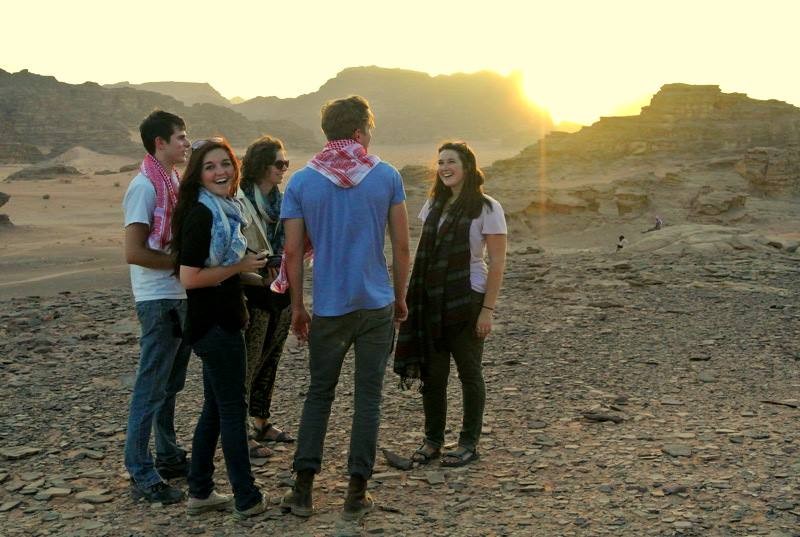

My adventures abroad in Amman, Jordan was one of the most exciting yet toughest experiences of my life to date. In thinking back on my experience I have compiled a list of tips, must do’s, and keep-away-froms.
1. For shopping, cafes, and just hanging out – Go to Jebel Al-Webdeh. Webdeh is in the old part of Amman, and is a great little hipster neighborhood that can meet all your coffee-sheesha-souq shopping needs. There are delicious falafel stands, amazing places for local music and a really rad youth culture, as well as good shops for doing some tourist shopping (that isn’t overpriced, and don’t sell golden camel statues)

2. Learn the circle-system quickly! The roads in Amman are distinctly divided up into 7 huge round a bouts that cut diagonally down through the city. You’ll learn that giving directions to a cab driver generally begins with which circle you want to go to. Addresses aren’t totally a thing in Jordan, so you direct your cab driver based off of landmarks. You tell him you want to go near King Abdullah Mosque, then direct him from there. For all your directionally-challenged people like me, don’t worry, you’ll adapt quickly – or get lost a lot.
3. Sidewalks are not for walking – Being a pedestrian can be almost as wild of an adventure as being on the road! Most sidewalks have cars parked on them at some point, dip down and stop in the middle of no where, or have giant trees planted right in the middle to the point that you actually cannot walk on the sidewalk. I tried for maybe a month, and then just resigned myself to walking in the street most of the time.
4. Americans are slobs – by this I mean that the university students in Jordan really have their act together when it comes to fashion. There is certainly no such thing as wearing sweats or a hoodie to class. I wore my Debate Team hoodie and my hair in my staple messy bun one day, and looked homeless in comparison to these girls. The girls are incredibly beautiful, and match their ENTIRE outfits. I wear almost exclusively neutral tones because I am so bad at matching, so I had nothing on these women. They used elaborate colors and patterns to match their hijab to their overcoats to their purses and shoes and fingernails. The guys look equally put together, mostly wearing loafers, button ups and sweaters, and nice jeans. Paying $50 for American Eagle to rip holes in your jeans is definitely not a fashion statement here.

5. Eat Local! – You will fall in love with the local cuisine, just like studying abroad anywhere really. The falafel, hummus, and shawarma is absolutely unbeatable, and cheap! Eating local foods is significantly cheaper than eating American style food, so help your wallet and eat the local foods. For the absolute best hummus in Jordan, go downtown to Mataam Hashem… You won’t be disappointed.
6. Prices are negotiable – Learn to bargain, or your wallet will suffer from your American-ness. Prices of nearly everything in Jordan can be negotiated. This goes even beyond just taxis or souqs, I knew a group of about ten girls who went all together to get a gym membership and were even able to negotiate that price. Be prepared to haggle in the souqs, and to really hone your skills you can try downtown! It’s not being rude, it’s just part of the culture in many instances!
7. Finally, the Middle East WILL steal your heart. You might not notice it happening, but sooner or later, this region, the people, the sounds, and the sights will make you fall in love. Amman stole my heart my second weekend abroad, when I was lucky enough to attend a BBQ with some local friends who owned an olive tree farm that overlooked the Dead Sea. I sat in a large circle with delicious food, new friends, and could see the lights and the border of Palestine in the distance. I knew right then that the Middle East had gotten me, and I would probably be returning back for the rest of my life.
 – Tiffany Wilk, Study Abroad Assistant



 DU Abroad