Pegasus and Palm Trees in Ulaanbaatar

As of today, I’ve been living in Ulaanbaatar for about two weeks. The capital of Mongolia and now home to half the country’s population, the city can at times feel overwhelming. Construction on every corner has not yet changed the fact that the city barely has the infrastructure to support the influx of people. For me, this can be felt most evidently in the traffic. Traffic is a constant in the city. In every district, almost every hour, every day. The local UB dweller knows this, and is just as aggressive as any driver, dodging buses and playing chicken with oncoming cars to cross the street. When school started September 1st, teams of traffic police took to the streets, wielding whistles and fluorescent batons, conducting the traffic as though it were an orchestra. Courageous men, to stand in the middle of the street like that. Slightly suicidal, maybe, but courageous nonetheless.

Similarly, traffic laws we take for granted in the States are not quite as relevant in UB. Double parking seems to be the norm, and rules like leaving handicap spots open or wearing a seatbelt appear as more suggestions than anything else. That said, UB is a fairly simple place to navigate. The main thoroughfare, Peace Avenue, runs the length of the city, east to west. Follow Peace Avenue, and eventually you’ll come to Sukhbaatar Square, the city center. There sits the stately Government House, and surrounding it, several important buildings, including the Mongolian Stock Exchange, the City Administration, which is housed in a tall, sleek black building, and a large, pink opera house. All built in different decades, with very different architecture. Luckily, almost anything a person might need can be found in and around Sukhbaatar Square, including the State Department Store. Founded in 1921, the place has about five different levels, and holds everything from designer perfume to flat screen TVs, as well as a supermarket on the first floor.

Also luckily, my homestay is located directly off of Peace Avenue, in a tall apartment building, almost smack dab between Sukhbaatar Square and where I go to school in the SIT center, my study abroad program. And while it’s just about impossible to get lost on Peace Avenue, I have a thoroughly useless sense of direction, and I’ve come to rely on a handful of local landmarks to help me navigate the various, sometimes overwhelming, parts of the city.

Landmark #1: the Golden Pegasus

Every morning when I leave my apartment building to walk to school, this lovely scene greets me. I’m not sure if its a kind of park for the complex, or purely for asthetic value, but it ensures I never forget where I live.

IMG_0417

Landmark #2: the Officer’s Palace

Before I could nominally navigate my way around UB, the city would quickly become a blur of brown buildings and signs in cyrillic. If it weren’t for this flag memorial thingy, known as the Officer’s Palace, reminding me to turn left for the SIT center, I probably would have just kept walking all morning until I reached the ger district.

IMG_0418

Landmark #3: Blue Sky Tower

Comfortingly tall and blue, this building stands out, anchoring me to the center of the city. I’ve never been inside. I don’t really feel the need to. Just seeing its bright blue curves peeking out from behind grey buildings helps me orient myself in the city.

IMG_0430

Last but not least, landmark #4: Sukhbaatar Square

Directly in the middle of the city, Sukhbaatar Square provides the ultimate landmark for finding your way around UB. If I can find the square, then I’m that much closer to finding the one Mexican restaurant in the city, or the supermarket, or a real cup of coffee. It’s an essential, not to mention striking, part of the Ulaanbaatar.

IMG_0433

This last week has been a whirlwind of lectures, language classes, and city life. But I feel like I’m beginning to find my place in UB. As well as some pretty excellent vegetarian restaurants and expat cafes. Beyond that, I’m STOKED for this week, as we leave on Wednesday for the countryside! Goodbye cushy city life, hellooooo nomadic, one room family living!

Sunset view from my apartment homestay in UB. You can see the traffic lighting up Peace Avenue below.

A final note:

We were sent this article for one of our lectures. It’s a NatGeo article, so a quick read, and a really interesting perspective on the growth and change of the city and country.

http://ngm.nationalgeographic.com/2011/10/ulaanbaatar/belt-text

*This post (and others!) can also be found at my study abroad blog, www.excessivefreedom.wordpress.com


– Heather Cook, DUSA Blogger fall 2013
Traffic Reports

Your study abroad preparation check list probably includes things like brushing up on the local language, deciding what to pack, where you will be staying when you arrive etc. One thing it probably does not include is what crossing the road might be like. In the U.S. we are used to a very (well..sometimes) organized system. It is so ingrained in us that we have an automatic reaction to green lights, cross-walk signals and blinkers. Often times when you step foot (get it?) in another country it’s the simple daily tasks that can really push us into culture shock!

My preconceived notions of crossing the street around the world were similar to this: How to Cross the street in Sweden.

In the spring of 2012, I was on Semester at Sea’s ship sailing to 11 different countries in 3.5 months. The opportunity to compare cultures, food and languages was incredible but even the occasion to discuss differences in crossing the road in each country was fascinating! The following countries were some of the most memorable:

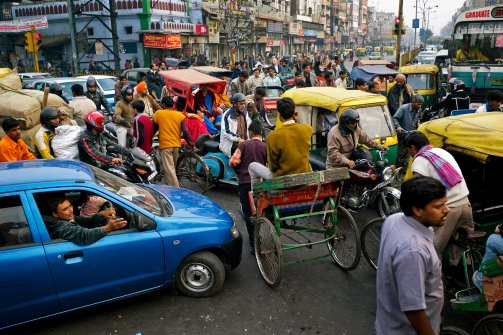
  • India, was a constant cluster of cars incessantly honking because bumper stickers on every vehicle told them to do so! Literally every car said ‘HORN PLEASE’. No one could ever sleep on a bus in India with the high pierced (imagine a cat screaming) car horn that they use. While on a tour bus headed to a temple with our group we got stuck in the middle of an intersection because of construction and confusion among drivers. While getting stuck, we “supposedly” hit another van that had stopped as well. I don’t recall hitting anyone but my opinion did not matter at this point. Our bus driver and the other driver started to yell at each other and we all sat silently, watching, waiting…and then out of nowhere the other driver ran around to our driver’s window and stole the keys right out of the ignition! Suddenly we were not only not moving but now our engine was off and the air conditioning ceased. What happened after that is a blur but I think our driver had to pay the other driver to get our keys back. We never made it to the temple that day but we did experience an interesting local altercation. Tip: It’s best not to get involved in arguments when you’re in a new culture, what might seem appropriate or polite to you may not be in the local culture.
india traffic
Traffic in India
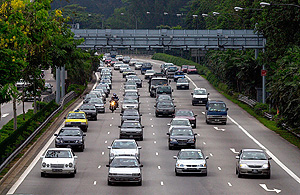
  • Singapore was very pleasant, while somewhat chaotic because of the amount of cars, it all felt under control because, of course, it was. The police have even created an English language website for assistance with crossing the street in Singapore.
Singapore-traffic
Traffic in Singapore
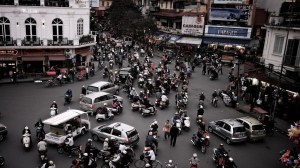
  • Viet Nam is a whole other story. Crossing the road in Viet Nam is like trying to cross a 4 lane high way in heavy traffic going 60 mph. The only trick to crossing the road in Viet Nam is to decide to go and walk at a slow and consistent pace so that the motorcycles and cars know how to maneuver around you. When you get to the curb you look at your friends and say ‘see ya on the other side!’ There’s also NO backing out once you commit to crossing the street, you have to go! I made that mistake once and almost got hit by a bus. My friend was smart and ran back, but it took me until I was in the middle of the intersection to realize I needed to NOT be there. Usually if a local was at the curb I’d stand beside them and follow their lead. Also, there are so many motorcycles in Viet Nam that it’s terrifying whether you are walking, in a bus or cab maneuvering through traffic. Everyone seems to think they have the right of way, yet somehow everyone moves around each other and makes it work…for the most part. I mostly just closed my eyes and prayed.
vietnam traffic
Traffic in Viet Nam
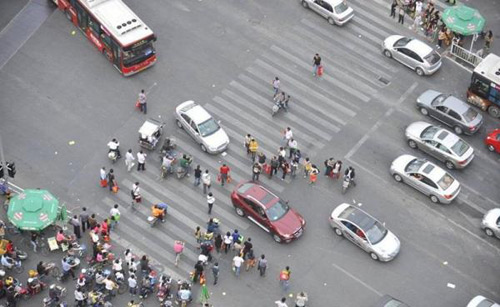
  • So, when we were preparing for China we were told that crossing the street is similar to Viet Nam but the traffic will not go around you, they will hit you. That was comforting. Some people make it their goal never to cross the road when they go to China. I understand why now. In Shanghai there were a lot of traffic lights and cross walks with the green or red person telling you when it was safe, however the taxis did not obey those rules. Turns out red is just a suggestion.
Crossing the street in China, be careful!

So, keep in mind that something as simple as crossing the street can become quite the adventure if you’re not careful! Learn the rules of the roads, what’s considered ‘normal’ like walking out into moving traffic in Viet Nam and use common sense!

– Kathleen Horn, Program Coordinator, Office of International Education at DU