The “studying abroad” in study abroad

“Am I going to fail my classes abroad?”  “Are my grades from abroad going to transfer back?”  “How could I possibly take a history class in a foreign language?”  It’s normal to have a fair amount of anxiety about being a student in another country.  Here are some tips and things to keep in mind!  

Expect a different academic environment and experience.  Don’t make assumptions that things will be like your college courses at home.  When in doubt, ask questions!  Reach out for tutoring, if needed.  While you can’t control the new academic environment, you can control how hard you try.  Typically (and generally), good students at home make good students abroad.

Don’t fall for the “my-classes-are-so-easy-because-I-don’t-have-homework” syndrome.  In many other countries, courses do not include such a plethora of opportunities to earn your grade like in the US; such as quizes, homework assignments, papers, and group projects.  Instead, your grade may be determined by only one final exam and/or one paper.  So just because you don’t have a homework assignment each week, you should be doing your readings and learning the content as you go, on your own.  Many a study abroad student has learned this the hard way when final exam time comes around!  And hey, it’s kinda like practice for graduate school….

Grading may be different.  You’ve heard of “grade inflation, ” right?  It turns out that compared to many other countries, the US of A really does have a severe case of it.  In many other countries, most students are “average,” by definition.  Often, the perception in the U.S. is that you start out the class with an “A,” and you lose points if you don’t fulfill requirements of the course.  In many other countries, the philosophy is more that you start out with an “F,” and have to earn your way up from there.  Top grades are truly only given to students who go far above and beyond the norm.  And in some countries, the grading is entirely on a curve, meaning that you’ll be graded solely on how you compare with your classmates.

Figure out who your classmates will be.

  • If you’re studying in a foreign language, but taking classes only with other international students like yourself, keep in mind that the professor (and the course) is very aware that you are learning the language.  Don’t be intimidated to take classes in a foreign language — they will be targeted for students are your particular language level.
  • If you’re taking classes with local students, you will be subject to the local way of teaching and learning.  Be sure to reach out to your classmates to get suggestions on how they study and prepare for exams.

But even keeping all of those things in mind, don’t over-generalize.  You may get some suggestions and generalizations from students who have gone on your program before, but it’s also important to consider two things:

  1. Every student is different.  Your perception of your academic experience will vary from the other students in the exact same class.
  2.  Every professor is different.  Just like at home,  the person teaching your course will profoundly affect the course content, structure, and difficulty.

So try NOT to fall into the trap of believing or making broad general statements about studying in your host country.

What classroom experiences did you have studying abroad?  What did you gain from learning in a new academic environment?  Did you find yourself making broad generalizations about academics in your country when you came home?

Top 10 Things To Do in Cape Town

If you’re studying abroad in Southern Africa, visiting Cape Town, South Africa is a must. It’s a gorgeous city, nestled beneath Table Mountain, and located right on the Atlantic Ocean. I went on an eight-day trip to Cape Town while on my semester break from the University of KwaZulu-Natal, and it was absolutely incredible. If you’ve only got a week to explore the city, here are some top things that you must do.

1)      Stay in a hostel

This is a general rule no matter where you travel. Sure, staying in a hostel is an economically wise decision (they tend to be pretty cheap), but it’s also a great way to meet people from all over the world. While staying at a hostel in Cape Town, I met people from New Zealand, Norway, England, Germany, Northern Ireland, Italy, Japan, Belgium, and The Netherlands. I had stayed in hostels in other cities in South Africa during my travels, and I even bumped into a guy from Peru that I had met at a hostel in Durban halfway up Table Mountain on my climb. The conversations and connections made in hostels are so special – there are so many perspectives and cultures that people bring to the table, and it’s always great to build some new international friendships!

2)      Climb Table Mountain

Flying into Cape Town, Table Mountain is the first thing that you will see. It is a large, gorgeous mountain that juts up directly behind the city. There is a large gondola that goes from the bottom of the mountain to the top, but for the adventurous type, climbing up is definitely the way to go. It starts out as a pretty easy hike, but by the time you hit the middle of the climb it turns into a super steep uphill grade. My friend and I ended up climbing on all fours to reach the top. During the climb we went through thick fog and gusty winds, which made the view at the top even more gratifying and spectacular.

3)      Robben Island

This is absolutely a must-go! It is so important to learn about the history and culture of the country that you are studying abroad in and/or visiting, and Robben Island is rich in South African history. This is the island that former South African president Nelson Mandela was imprisoned on for eighteen years. The most amazing part about visiting the island was that all of the people that currently work there were once a) prisoners or b) prison guards. These people now live and work side-by-side and have put many of their differences aside. It was incredible to hear about the history of the island from people that had lived through its past.  

4)      Go on a wine tour

Located very near Cape Town is the wine region of South Africa. There are various tour companies that will pick you up from hostels located throughout the city, and will drive you to several different vineyards throughout the day. Not only is there fantastic wine, but the vineyards are absolutely beautiful. Take a day and do a wine tour to see and experience all that the area offers.

5)      Boulders Beach

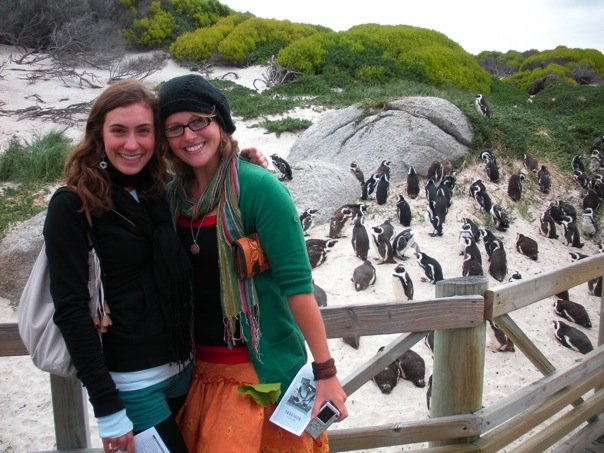
Who doesn’t love penguins?! Boulders Beach is the home of the African penguin. Stop by Boulders Beach and take a look!

6)      Cape of Good Hope/Cape Point

Part of Table Mountain National Park, the Cape of Good Hope Nature Reserve is a beautiful, rocky cape along the Atlantic Ocean. Cape Point is the most south-eastern point of Africa, and it is part of the National Park as well. Stunningly beautiful, these are two must-see locations. The Park is also full of baboons, so hold onto your belongings – they have been known to steal food and other small items right out of the hands of people!

7)      Seal Island

If you’ve ever watched the BBC’s Planet Earth episode on Seal Island, you would know how incredibly cool this place is. When you arrive at the island, you don’t just see one or two seals, but HUNDREDS. They are everywhere – sunbathing on the rocks, swimming in the water… it’s a pretty awesome spot.

8)      Kirstenbosch National Botanical Gardens

I’ve always loved being in a beautiful garden, but Kirstenbosch is at a completely different level. With Table Mountain jutting up behind it, and vibrant, colorful flowers everywhere you turn, its beauty borders on magic. Go for a walk, have a picnic, or grab lunch at the beautiful outdoor restaurant and soak in all that Kirstenbosch has to offer.

9)      World of Birds Wildlife Sanctuary and Monkey Park

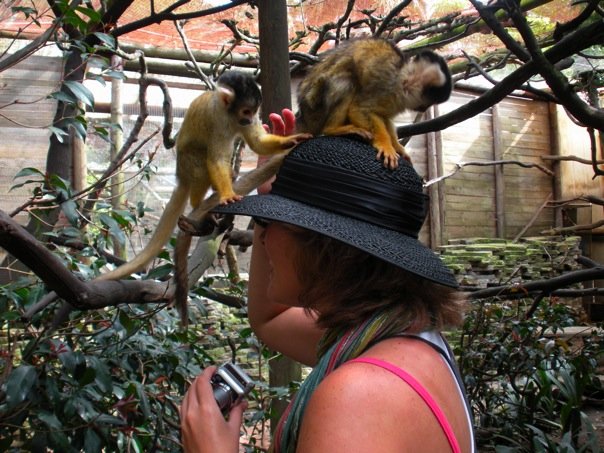
My friend and I happened upon the World of Birds Wildlife Sanctuary and Monkey Park completely by accident, but it ended up being a highlight of our time in Cape Town. There are hundreds of beautiful birds in the Sanctuary, but also tons of monkeys that we got to hang out with – literally. The monkeys were crawling all over us, which was a little unusual, but tons of fun.

10)   Sandboarding at Atlantis Sand Dunes

If you like snowboarding, you need to give sandboarding a try. It’s HARD – but really fun! Atlantis Sand Dunes are located right outside Cape Town, and there are several adventure companies that take people out to the dunes a couple times a day. Honestly, I spent most of the time sitting on my behind (and I was washing sand out of my ears for days), but the few times that I made it down the hill were super rewarding and a lot of fun.

Christina Hunter, DU Alum, Office of Internationalization Staff