Missing Pets While Abroad- Missing my cat, missing my dog, and discovering missing barking

An easy thing that comes to mind when people ask me if I miss home is my pets.  Missing them is just as applicable when I’m here in Denver studying, as it was when I was in Seoul studying abroad. I miss playing in the deep Minnesota snow with my dogs, making snowmonsters that Monte attacks and destroys—tearing down what took 10-15 minutes to make in less than 10 seconds.  I miss our cats that climb up into my lap to be petted.  And I miss discovering baby kittens on our farm.

I learned that in South Korea, most Koreans prefer dogs to cats and see cats as a dirtier animal.  Do people prefer cats or dogs in the country you visited?

One of the highlights of my time in Korea was spending a few weekends at my friend’s home, with her super cute small white terrier.

This is Nana. She looks cuter with hair.

That is when I learned that it is common for owners in Korea to de-bark their dogs.  I was shocked. I didn’t know the procedure even existed. Well, it does. And people in the United States practice it too; it’s just not widely advertised by veterinarians who practice debarking.

If you want to learn more, check out the 2010 New York Times article by Sam Dolnick titled Heel. Sit. Whisper. Good Dog.

Colorado appears to be full of dog-lovers, and I expect most Coloradans who read this will instantly object. But after looking into the procedure of de-vocalization, it doesn’t bother me very much.  It is a procedure done for humans’ convenience; it seems comparable to de-clawing cats.  Additionally, dogs recover quickly, and it doesn’t turn them into unhappy pets.

The procedure has been has been done for decades and animals can generally still make wheezing or squeaking noises.  There isn’t data available to tell us how many dogs have been devocalized, but experts say that it is most common in private homes, dogs who compete in show circuits, and in drug dealers’ attack dogs.

On the other hand, I doubt I’d ever do that to my own pet in my lifetime.  Devocalization is banned in New Jersey except for medical reasons, in Ohio it can only be done on nonviolent dogs, and is banned in European countries as well (Dolnick, 2010).

What do you think? Would you ever de-bark your dog, like they do in other parts of the world? Have you ever de-clawed your cat? Have you met a de-barked dog? Was it happy?

-Emilie, Peer Advisor


Culture Shock and the Greatest Graphic Ever

Culture Shock may be the most blandly defined word ever. The Merriam-Webster Dictionary calls it “a feeling of confusion, doubt, or nervousness caused by being in a place (such as a foreign country) that is very different from what you are used to.”

Blah blah blah, bored bored bored. Enough already.

It is truly astounding that a definition can fall so short. True culture shock is elation and terror, excitement and frustration, adventure and nostalgia. While these pairs seem to be in conflict with each other, in reality, they act in perfect harmony, albeit one might be acting a bit more strongly than the other. Let me explain.

Goofing around the Royal Palace of Madrid

Truly being in a new culture, for me, comes down to an internal battle between adventure and nostalgia, as I mentioned before. While traveling, carpe diem (YOLO for all you hooligans out there) seems to rule my psyche. I want to see everything, do everything, and experience every little facet that will imbue the place to me. For example, when I was in London this past September, my travel partner and I decided to walk from our hostel near King’s Cross to London’s Natural History Museum (our route).

Had we walked straight there, it would have been 7 miles. All of our detouring and site-seeing probably brought us up to 9. We talked in British accents, took pictures, ate lunch in St. James Park, and tried to grasp the fact that we were thousands of miles away from home. We turned our excitement up to 11, culture shock was staring me straight in the face, and life couldn’t have been sweeter.

That’s the upside to culture shock: it can be riveting and awesome, new and shiny.

Then there’s the flipside: the nostalgia of everything you left behind.  Whether it’s friends, a significant other, a physical location, or your family, you made sacrifices to “live the dream”, so to speak. At first, you’re too caught up in the moment to realize this; while every cloud has a silver lining, every warm, sunny day gives you a higher chance of contracting melanoma. Wow that was incredibly insensitive. I’m going to rephrase, hyperbole and melodrama aside.

The point I’m (so offensively) trying to make is that culture shock is a double-edged sword. Going abroad is a fantastic journey that can come at personal sacrifice. That being said, I believe the benefits outweigh the shortcomings tenfold. No, everything will not be just as you left it, but that can be a blessing in disguise and the relationships that really matter will deepen.

Culture Shock: Jump In

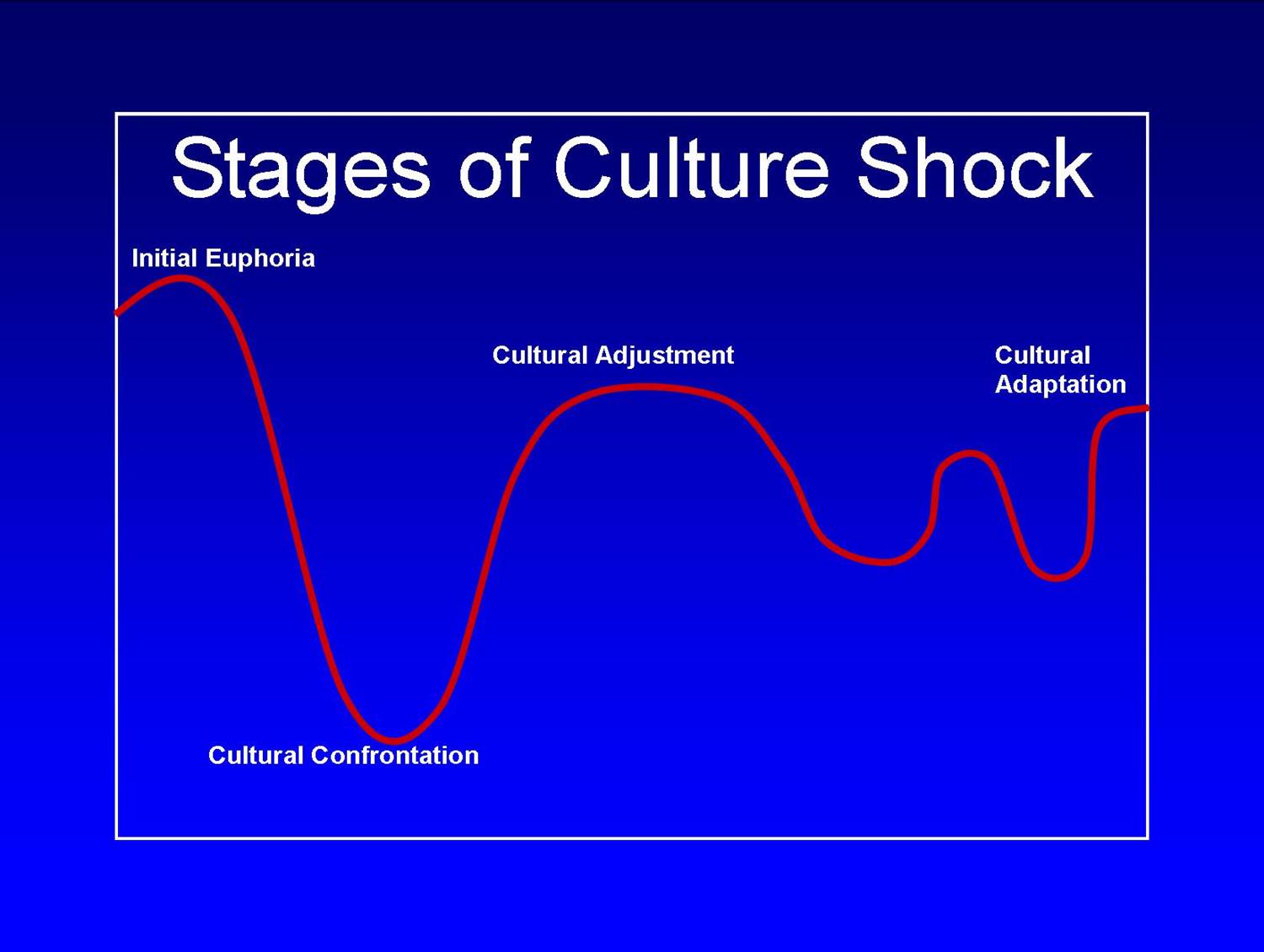
Now, the greatest graphic ever. You will forget just about everything the Study Abroad Office tells you before you go abroad. We do our best, but the reality of the situation is that a lot of information falls through the cracks. The one piece that will remain with you when you come home from your grand adventure is the graphic below:


GREATEST POWERPOINT SLIDE EVERRRRR

This is you over time. As you slowly assimilate into your host-country’s culture, there will be ups and downs. Always remember, though, that no matter how low you go, if you keep working hard, the next euphoric moment is right around the corner.

Max Spiro, Peer Advisor