
How do you handle pressure?
How do you handle conflict?
Tell me how you handled a difficult situation.
Tell me about a time when you faced some adversity in your life and how you overcame it.
Study abroad- while we returnees tend to focus on the amazingness of our experiences abroad, it is hard to imagine a study abroad experience without some sort of adversity, difficult situation, conflict or pressure. This adversity is meant to be capitalized upon. Use your experience to prove to employers that you are resilient and you have what they need.
Are you a leader or a follower?
Tell me about an accomplishment you are most proud of.
Give me one example of when you’ve used your problem-solving skills.
Tell me about a time you made a mistake.
Tell me about a time you failed, what you learned from it, and how you would act differently if you encountered something similar again.
Let’s imagine you are one of three candidates in a final round of interviewing, all with similar qualifications, skills, and background. Except for one thing: you studied abroad. Are you prepared to convince the interviewer of the value added you can bring to their company because of your study abroad experience?
Or let’s imagine you and the other candidates all have same qualifications and all studied abroad. Can you make yourself stand out in a crowd with a study abroad experience that shows a combination of desirable skills? Most of us are probably thinking, no, not yet, I couldn’t do that in this very moment.
The thing about professional development—preparing documents required for job applications and job searching in general—is that it is a process of research, reflection, and improvement. We research positions and required qualifications, we match our skillsets with the job descriptions’ vocabulary, and we practice aloud our rationale of how we match the position.
It is often easy with study abroad experiences to follow the STAR method- Situation, Task, Action, Result; proving your skills through a story. Go back to the list of questions; did any of them resonate with you and of one of your study abroad experiences? Try to set up your story in the STAR method to demonstrate skills like flexibility, active listening, ability to work with people different than yourself, solving problems, critical thinking, and managing conflict.
By using your study abroad experiences in interviews you are displaying maturity through the reflection it took to draw out those skills. It is also a great topic that creates an opening for more conversation. Use your study abroad stories to help you land your next job.
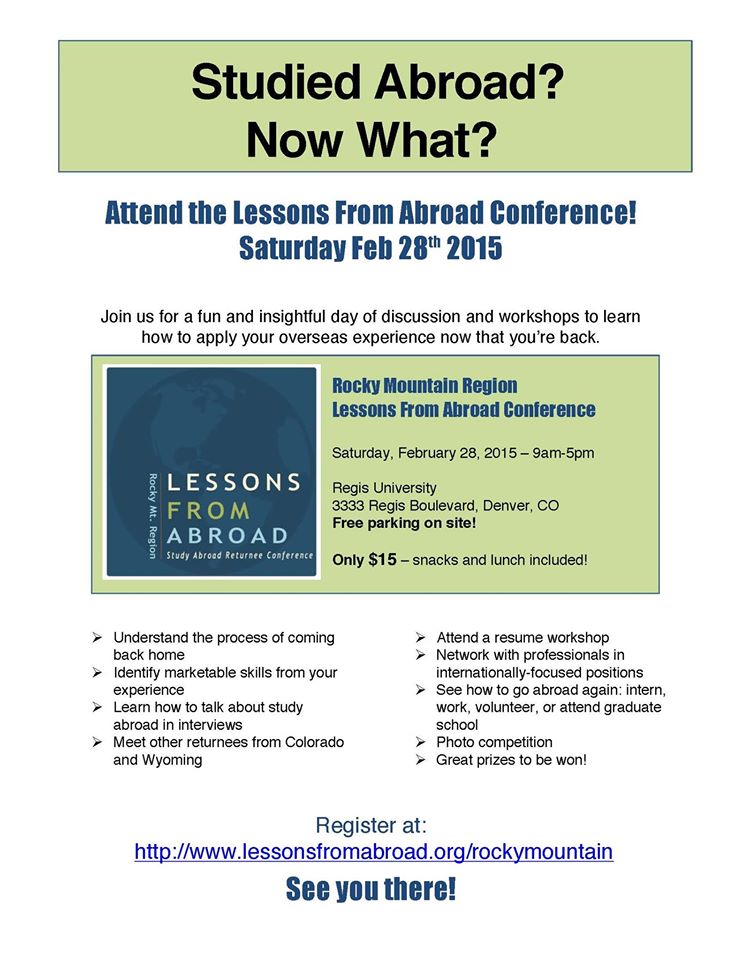
Finally, look for the annual Lessons From Abroad—Study Abroad Returnee Conference in your region to learn how to improve your resume writing and interviewing skills. You will also have the opportunity to network with professionals who have internationally-focused positions and learn how to work, teach, or volunteer abroad after graduation. http://www.lessonsfromabroad.org/








 DU Abroad