
Cuba Libre

Studying abroad causes many to become infected with the proverbial “travel bug.” As a result, many decide to travel after their program is finished, extending their stay to do more domestic travel or visit other neighboring countries. This is a decision I made, delaying my departure two weeks to travel to Havana, Cuba.

I was fortunate enough to study abroad in Kingston, Jamaica. Living on an island leaves one with two options in regards to additional travel, either you explore more of the island or you leave the country. Jamaica is relatively big and has an extensive tourist infrastructure, so there are plenty of opportunities to do domestic travel. My program did a great job of exposing us to multiple parts of the island, so I did not have an urge to do more travel within the country. When it comes to international travel, there are various islands that are relatively easy to visit (Cayman Islands, British Virgin Islands, etc..). However, you are more or less going to get a similar experience; comparable language, food and lifestyle. As a result, another student and I decided that we must expand our search.

Photo: www.tropicanacruises.com
Photo: http://www.tropicanacruises.com

Cuba represented a logical choice for us; I thought it would be a once in a lifetime opportunity and my companion had family on the island, so we had a place to stay once there. While planning we had to first figure out how to get there. There were weekly flights to Cuba from Kingston, so that was not a problem. The only downside is one airline had a monopoly on the service, Air Jamaica, making the 60 minute flight very expensive. Second, we had to figure out if it was even possible to visit Cuba on American passports. The short answer is that it is possible, but somewhat difficult. The country issues tourist cards for American citizens, giving immigration something else to stamp other than your passport.  However, at that time there were heavier restrictions on travel than there are now, making travel to the island more difficult and increasing our risk. Lastly, we had to research how money exchange works on the island. Since there is an embargo and were heavy restrictions regarding U.S. currency, we discovered that credit cards and travelers checks did not work.  We found that we would have to exchange our money into different currencies and make sure to plan out exactly how much we were going to spend. This last point made me more nervous than anything else because I feared that we might run out or lose our money. Once we solved these issues, we reserved our trip and made the necessary arraignments. Needless to say, we had an amazing experience that was furthered by the fact that we had just finished an intense study abroad program and were going to a place that was ideologically and socially very different than anything we had previously experienced.
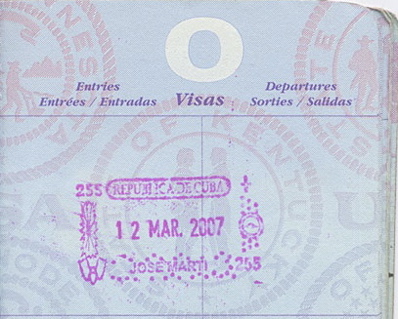
Photo: washingtonnote.com

Traveling after your program is finished will force you to prioritize. In my case I had to determine if:  (1) It was even possible, (2) what are the ways to do it and (3) does it fit into my budget and if so, what monetary considerations do I need to make. Many of you will have the same dilemma. I recommend that if you are determined to do something you make it happen. Otherwise, you will always be wondering, what if?

Pablo Hester, DU Abroad Peer Advisor

Blending in while abroad

When traveling abroad people will notice your “American-ness,” regardless of race, gender, ethnicity or sexual orientation. The simple fact is that this country leaves an indelible mark on you, from your sense of style, actions, mannerisms or political viewpoint that will be “tells” indicating your foreignness.

In no way am I trying to attack individuality, it has just been my experience that there are some things that stick out in me that indicate I am from the U.S. I have had the unique opportunity to travel to 18 different countries. My mother is Mexican-American and my father is Afro-Jamaican. I always thought that my racial ambiguity would be a sort of shield in traversing the globe; believing it protected me from American stereotypes, which can cause challenges or misunderstandings. In many respects, this has been the case. For instance, it is much easier for me to walk down the streets of Kingston, Jamaica as a “brown” male, regardless of my heritage, when compared to a “white” female.

However, this has not always been the case. One instance in particular, while traveling on a crowded bus through the Andes, let me know just how telling my “Americaness” was. I am very self-conscious about my Spanish; it is not very good and my accent is very noticeably American. As a result, I try never to speak too loudly in public settings, and limit how much I say so I don’t stand out. Also, as I mentioned earlier, I could easily be mistaken as a resident of any number of countries in the region. However,  in this instance, I was called out by one of the traveling salesman that hop on and off the bus at every stop, as he referred to me as “Yankee” without me doing or saying anything.

This was not the first and probably won’t be the last time I will be viewed as an American without displaying any obvious indicators. But, I have found ways to limit the exposure of those “tells,” regardless of who you are:

  1. Don’t bring white name-brand sneakers. Shoes are a luxury in much of the world. If you are lucky enough to have two pairs, one is designated for everyday living and the other for church or other formal engagements. Wearing nice white sneakers are a dead giveaway that you are a foreigner and have the means to afford a shoe that gets dirty quickly.
  2. Keep your University of Denver shirts, hoodies and sweatpants at home-You are basically wearing a big sign on your chest that indicates where you are from, your age and why you are there. Also, this attire is informal, which is odd in much of the world.
  3. Keep your voice down-Yes, it is true, Americans are loud and very opinionated. There’s nothing wrong with this fact, however, there is a time and place for everything and sitting on a quite bus is no place to complain about a lack of facilities, or being hungry, or feeling “gross.”
  4.  Walk upright and be confident-Of course you are unsure about where you are going and what you are doing. Who wouldn’t be in a foreign country with a foreign language? The point is that nobody else needs to know. Be confident in your direction and walk down the street with a sense of purpose.  Aggressive vendors love tourists who have wandering eyes and walk a stop-and-go pace. 

– Pablo Hester, DUSA Graduate Peer Advisor