
Lessons Learned From First Term

My first term at the University of York is drawing to a close, and as I prepare to head home for Christmas and New Year’s, I’ve put together some things I’ve learned about living as an American in England after my first chunk of my exchange year.

  1. Yorkshire is a county full of immense local pride. Nothing quite brings that to your attention like standing in a crowd of locals at a concert who are all chanting “York-shire! York-shire!” Nothing quite makes you feel as viscerally at home than joining in that chant and having it swell to the point where you can feel it resonate in your chest.
An American and a German at a British rock concert.
  • Nothing teaches you humility like trying to learn all the ins and outs of life in North Yorkshire. Most of the locals have been happy to explain everything to me from how FIFA works, to how a football team makes the world cup, to why people care so much about football in the first place, to what on earth a “brolly” is (Hint: it’s an umbrella). Sometimes you can pick up on cultural nuances via context clues, but sometimes you can’t. And that’s fine! Plucking up the courage to ask what may be a pretty obvious question is an exercise in humility that everyone needs eventually. And it opens up an opportunity for locals to demonstrate kindness and patience towards you. Which, more often than not, they are happy to do.
  • England and America are two countries divided by a common language. Should you choose to go abroad anywhere in the UK, don’t underestimate the differences in these dialects and the cultural differences they bring. You’ll inevitably slip up at some point and say something embarrassing. It’s alright. It’ll happen. But the key to managing a new culture (even one that may not seem that different than home), is always listening. Go and spend time with just local people for awhile (as in actively seek out local company rather than just hanging out with other international students. You already know how to relate to Americans, it’s not going to challenge you to relate to them in another country) and just listen to the conversation before jumping in. English folks have very different methods of making friends than Americans, and you can really only learn this on the job.

A very British Christmas: Love Actually, wine, and Christmas crackers!
  • A political discussion is going to eventually come up. At some point, it’s likely that whomever you’re talking to will criticize something about America. You may or may not agree with said criticism. Whatever your opinion, wait before jumping to defend your home country. Probe a little. Ask more questions. Figure out what is influencing this person to think the way that they do. Then add your own opinion to the mix. Not only does this make for a more fruitful exchange, it sends a more positive message about Americans in general-that they’re politically aware and willing to try to see issues on a global scale, rather than just a countrywide one. And do keep in mind that every country in the world has serious issues and has made serious mistakes. Admitting to and expressing shame or sorrow over mistakes our nation has made doesn’t make you unpatriotic. It makes you honest.

Exploring the northern reaches of Britain in Edinburgh.
  • And finally, on a lighter note, give yourself permission to be silly. Everyone’s got a goofy side, and it often gives others permission to unleash their goofiness when they see yours. Even if (in my case) that means screeching your way through a karaoke rendition of the Time Warp. People will wonder how many drinks it took for you to pull off that entire dance and all the spoken bits (the answer, surprisingly, as zero. The karaoke bar in question was really expensive). But then they’ll quit wondering and dance the Time Warp with you in the haze of the fake smoke machine and leave breathless and grinning. And it’s moments like those, in addition to the more serious ones, where international bridges are built and some special friendships are formed, when people don’t feel the need to choose between silliness and seriousness. Both are integral parts of being human, I think.

It’s been a fantastic first term. For those of you heading back to the States for good, don’t let your experience fade. Write about it and preserve it. For those of you staying abroad for the whole year-we’re just getting started. Let’s make it count.

-Faith Lierheimer, DUSA blogger

Intercambios Saved My Spanish

After more than a month in Spain, I have a new level of respect for anyone who decides to move to a country where they will have to speak a different language. Even the simplest sentiments can be difficult to translate. Oftentimes, it takes me about twice as long to say the same sentence in Spanish as it would take to say it in English. Sometimes I hold up my hand, say “espera,” and take a minute to search for the word I need. And every once in a while, after staring into space for far too long, I sigh and say, “no importa.”

Though I try to practice as much as possible, it hasn’t been as easy as I expected. Originally, I imagined myself speaking Spanish all the time once I got off the plane in Madrid but it soon became clear that our program coordinators were going to communicate with us almost exclusively in English. Whenever I was hanging out with other people in my program they spoke English too. After a couple weeks I felt myself comfortably slipping into speaking English whenever I could, which was often, considering all my friends were Americans from our program.

Wait, I would think every so often. This isn’t what I came here to do. It felt wrong to only ever be speaking in Spanish when I was with my host mom or in class. Wasn’t I supposed to be trying to immerse myself in this new language? At the same time, I didn’t want to ask my friends to try to have Spanish-only conversations with me, and I really did not want to attempt to ask a native speaker if they ever wanted to chat. I’ve played out the scenario in my head, and the only way it ever ends is badly. So badly. And awkwardly.

The perfect solution to my problem came a few weeks after we started classes: an intercambio. In Spanish, the word intercambio means “exchange,” and in this instance the exchange is vocal. Our university matches us up with a native Spanish-speaking university student who wants to practice speaking English and, once we’re given their contact information, it’s up to us to set up a meeting and start practicing.

Intercambios are the best thing to happen to my Spanish conversational skills since the Spanishdict app. I’ve met with many of my friends’ intercambios as well as my own, and they are all extremely friendly and speak near-flawless English too boot. They help you with your grammar mistakes and teach you slang that varies from the useful to the, well, less-than-appropriate.

One of the sights I saw while exploring Sevilla with my intercambio - Plaza de España
One of the sights I saw while exploring Sevilla with my intercambio – Plaza de España

The other night I had my first dinner out where it was just me with my intercambio and her Spanish-speaking friends. To say the least, it was intimidating. Not a word of English was spoken. Many times I ended up grimacing because I wasn’t sure if I was supposed to react with surprise, disgust, or happiness. The pace of conversation was so fast that whole minutes passed with stories flying over my head as constantly nibbled on my food to make it look like I had a reason for my silence. Every once in a while, my intercambio would turn to me and translate a story that had just passed, rapid-fire and full of slang I don’t know, between her two friends.

Though the experience may have been a little bewildering, it was fulfilling in a way that spending a night speaking in English wouldn’t have been. I felt like, though I struggled, I was accomplished in some way.

And the things worth accomplishing, the ones that leave us with a sense of pride after we’ve achieved them, are the ones that present the hardest struggle along the way.

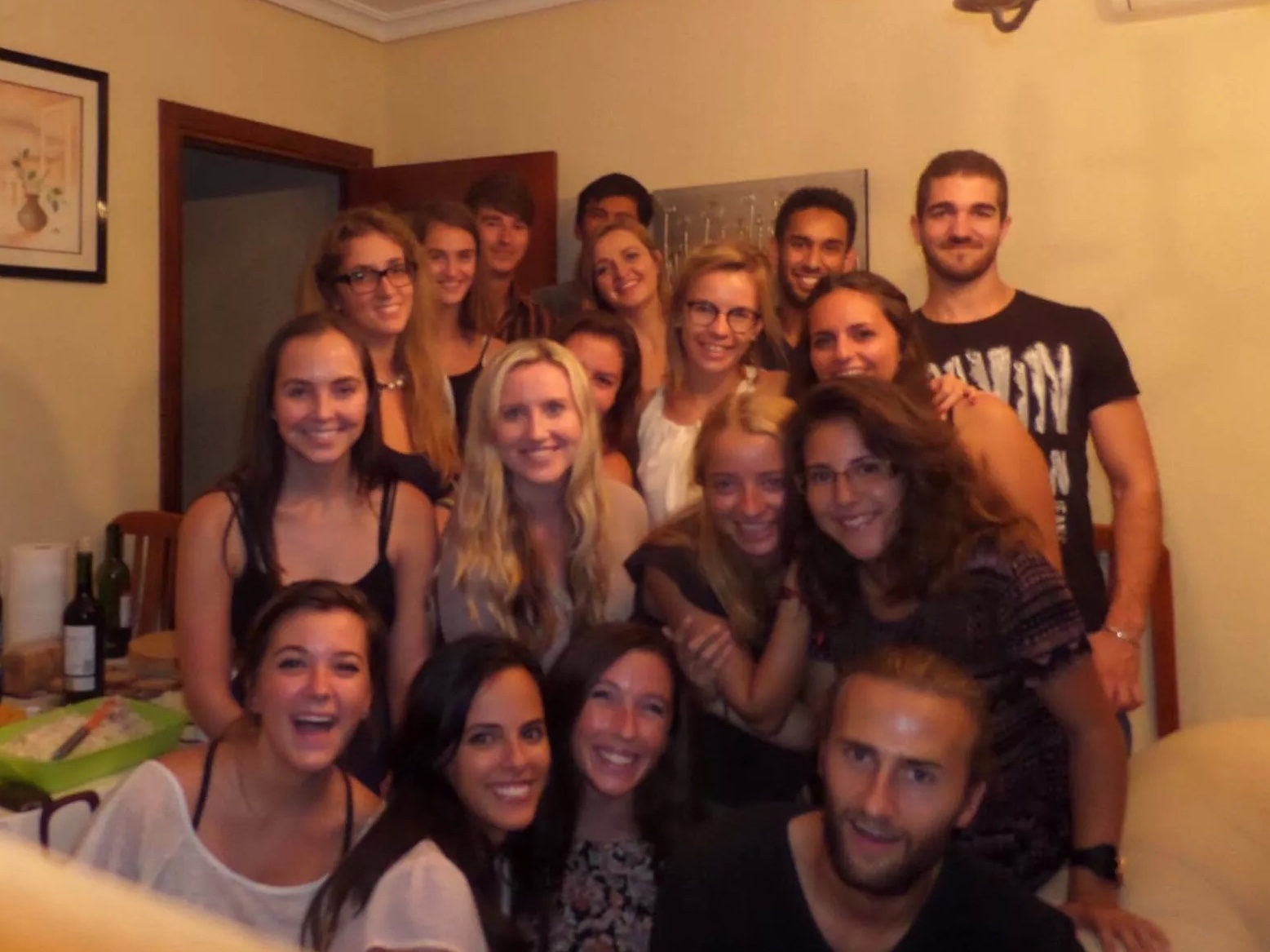
Intercambio night! Spaniards, Americans, Brits, Germans, and more.

To help with navigating the struggle that is overcoming the language barrier, I’ve compiled some facts/ tips that I’ve picked up in the last month and a half:

  • You will be scared. Don’t be. Nervousness may keep you from saying something wrong, but it will never allow you the chance to learn how to say it right.
  • (Most) people appreciate your efforts. Speaking in a country’s native language shows an appreciation for the people and their culture, and you are more likely to run into people who will help you through a conversation than people who will judge you for your mistakes.
  • Learning a language takes time; progress may seem slow, but as long as you keep practicing it will happen. Everyday phrases will become easier when you actually start using them everyday.
  • Sometimes the only reason you understand what people are saying is because of the accompanying hand signals they make.
    • Just today I had an entire conversation with my tapas professor using hand motions and sounds to imitate what food would sound like in the pan. Seriously. (And it was probably the most entertaining conversation I had all day). You can get by even when you don’t have the words to, so don’t get flustered when you can’t figure out what you need to say.

Emily Laurinec-Studer, DUSA blogger