
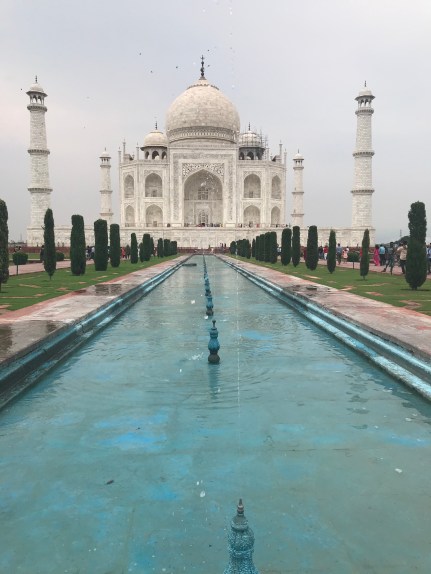
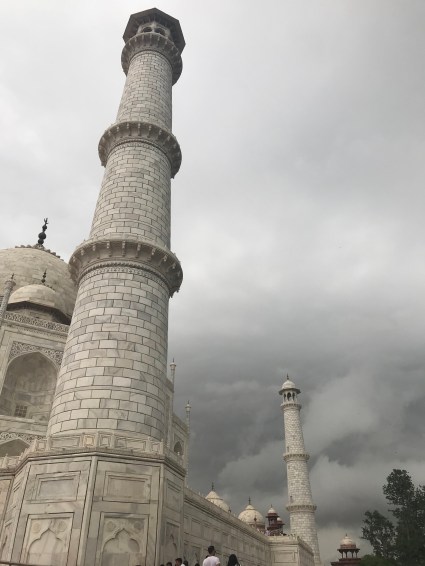
The people’s voices around me were silenced for a moment as thunder rumbled in the distance. The sky was getting progressively darker and angrier since the group rode the electric bus to the entrance of the Taj Mahal. Wind billowed past me and made my brown Ali Baba pants expand even more. The animals around me felt the moisture in the air; birds flew to the west, monkeys hopped to the safety of the trees. It felt as though hands were touching my shoulders and hair, voices whispering in my ear. Expecting other people around me to be affected by the weather, I turned to scan their faces. The three other girls and two boys were entranced by the tour guides words, which he had already performed for the third time today.
Behind them stood three Indian women in saris that were purple, green, and yellow. They stood motionless watching my group for what seemed like hours, not even slightly embarrassed if one of us glanced over at them. Their eyes were narrowed as they eavesdropped on our conversation by standing only five feet away. It seemed to be a look of curiosity rather than anger, only hoping to see a foreigner in the flesh.
As I looked to the right of the women, I realized that none of the people around me were even looking at the Taj Mahal. They either stared at the screen in front of them as they took hundreds of pictures of their loved ones or were facing the opposite direction smiling at the camera.
“This is the most beautiful thing I have ever seen in my life,” one of the classmates Katie said to me. “I’ve never been happier than this moment, right now. Like, I just want to stay here forever.”
I nodded in agreement and smiled at her. Yet underneath the beauty of the Taj Mahal, I felt an energy creeping towards me, as if it lived in the palace and waited for one of its guests to recognize it. I shook it off as I remembered that this was a magical place that is often referred to as the “monument of love”.
The tour guide walked a couple of feet in front of the group and would glance back regularly to make sure we were close behind. He led us towards the base of the Taj Mahal where there were two different entrances with guards pointing people towards each one. The guide motioned for us to follow him towards the left through a small opening in the gate and marble wall. We snaked around the walkway and followed the rest of the tourists up towards the entrance, where we would be able to see the tombs of Shah Jahan and Mumtaj Mahal.
When we got to the top of the walkway, I heard repeated whistles coming from below me. The guards were yelling at the native Indians when they tried to come through the same way as the tourists did. With a sweep of their hand, the guards pushed the natives aside and told them to go to the right, where there was no walkway, but only a longer distance for them to walk. More stairs to climb, while I was able to walk up a flat surface. They were forced to leave their shoes unattended at the base, while I was able to slip a cover over my shoes.
At the entrance, the tourists and natives intersected in the middle, facing a collision of cultures and bodies, leaving everyone wide eyed. An elderly woman in a wheelchair was lifted up all fifteen steps by her family so that she would be able to see this magnificent creation. No one moved aside for her, though, while I, on the other hand, was funneled front row and given the best view of everyone else.
The inside was lit up only by the small slivers of light coming through the honeycomb holes in the marble. The wind followed me through as I walked, gently pushing me from behind to quicken my pace. The other members of my group were far behind me as I exited the building. The rain finally decided to make an appearance as it ran down the marble walls and puddled at the base. People stood on the back portion that looked out at the Holy River which spooned the Taj Mahal, watching each other in an eerie silence.
Anne Berset
INDIA – UNIVERSITY OF HYERDERABAD, 2018 FALL
Anne Berset is double majoring in Creative Writing and Psychology as well as a minor in Philosophy. She is studying at the University of Hyderabad in India for the Fall term, where she will be taking philosophy and political science courses. She hopes to gain a new perspective on culture, politics, and religion while abroad. Anne loves to watch films, go on hikes, and spend time with animals.