Eurail & train pros & cons

A personal anthology of Everything Eurail. Everything I wish I knew before traveling around Europe by train (info that even TikTok won’t be able to help you with).

If you’re studying abroad in Europe, and want to travel as much as you can, you may want to consider the Eurail pass.

If you are currently a sophomore, or a junior reading this (and planning on studying abroad in the winter/spring, or even fall) Eurail pass does Black Friday sales. Which is absolutely worth it to buy in advance. It is a really good deal. You can buy your pass in advance, then you have up to a year to activate it whenever you want.

Here are some considerations and tips for choosing the best Eurail pass for you, and to help you decide if it is the right choice for you. As someone with a more limited abroad budget, it was absolutely worth it for me.

First, consider how close your host country is to the places you want to go. Or where you could travel to by train. For example, I was in Florence, Italy. I traveled around Italy by train, and to Slovenia, Austria, Germany, and took a train from London to Edinburgh/Belgium. As well as by train in the UK and the Netherlands. The train station was central in Florence, and easy to access, making trains a great, budget friendly travel choice.

If you’re planning on studying in the UK or nearby, I recommend the Eurail pass! Trains and transportation are VERY expensive in the UK. No matter the time of year. For example I traveled from London to Edinburgh, the train I took would have cost $150 for a 2nd class ticket. Which would be around 35% of my Eurail pass cost, but for just ONE trip.

Also consider how many trips you’ll want to take, and if you need to take high speed trains or not.

A great option for a semester abroad is the unlimited Eurail pass for 2 or 3 months. This is an amazing option for flexibility, budget, day trips and weekend trips. When you’re traveling by train in Europe , flexibility is KEY. It may seem like a lot up front. But it is worth it if you are going to be traveling every weekend (or almost every weekend). Plus it’s nice to get one travel expense out of the way. Take advantage of the Black Friday sale!

It may been intimidating or hard to know what Eurail pass to choose at first, but if you do some quick calculations you can decide which one is best for you.

For example, I had the 10 trip Eurail pass over two months. But I think the perfect pass choice would be 15 travel days over two months. Having the extra travel days for more flexibility and longer travel days is worth it.

Something else important to note, is the amount of months/days the pass will be valid for! If you want to spread out your trips, you definitely don’t want to do the limited number of days in one month. You will get a better value by doing the 10 or 15 days over two months, or unlimited. For example, I decided to extend my last trip by one day. But I forgot that my pass expired that next day. So when I got on the train I had to pay for a full ticket price, even though I still technically had a travel day left on my pass, it didn’t matter because my pass was expired.

Obviously Eurail pass is best for going location to location, not back and forth from one place (like weekend trips). However I was able to make it work no problem, and I really recommend it, as individual train ticket prices can be more expensive and change a LOT. Some people took 3-4 trains in Italy and it cost around the same price at my 10 day trip pass.

No one really talks about train strikes or warns you about them. Italy particularly, was a bit notorious for train strikes. I was not expecting them, didn’t know much about them, and wasn’t warned about them (even by my program in Florence). SO PSA: If you’re studying abroad in Italy and planning on taking trains, look in advance for train strikes. Most of them will be scheduled, but sometimes it’s hard to find specific information. Important lesson that I learned the hard way, if there’s a possibility or uncertainty of a strike, schedule around it. Or arrange backup plans. When I was in Italy, there were particularly many strikes, significantly more than other countries.

Other countries may also have train strikes. If you’re taking a train somewhere to/from a major city, check this before planning your trip. For example Netherlands, Germany, Paris, etc…

However this should not deter you from traveling by train, and you can easily avoid any issues by planning ahead.

Always book trains with at the MINIMUM 10 minutes between each other. But if possible, aim for 20-30 for transfer time. Most trains (especially regional ones can easily get behind schedule), and some train stations may be hard, or crowded to navigate. So most times you won’t even have to wait 1hr – 30 mins between trains, if you’re taking a regional train in any country.

A great pro of using a Eurail pass is having stop overs along the way to your destination! This is how I got to see multiple cities from just one trip/or travel day use. For example, I had a 6 hour stopover in Rome, a 4 hour stopover in Venice. So I got to explore them without using an extra travel day, or buying another ticket.

Lastly and most importantly. Travel days. Something I learned the hard way, is what was considered a ‘travel day’ for Eurail. I had to rework all my trips, and take more high speed trains, to try and just use two travel days for each weekend trip. This is a pro of the unlimited pass, you don’t need to worry about the number or travel days or taking late trains. But let me break it down for you:

When you get your Eurail pass you ‘activate’ it when you’re ready to take your first trip.

From that first activation, your month(ly) period begins. For example if you have a month long pass, and activate it on the 1st of September, it will expire on the 1st of October. Even if you don’t use all your travel days. So use your days before it expires!

You can choose what travel days to activate your pass on (if you have 10 or 15 travel days for example). You need to activate your travel day before getting on the train, or else you risk a fine.

A travel day is a period of 24 hours. Try to take trains earlier in the day to avoid having to use two travel days to get somewhere.

So let’s say you’re taking a train at 8pm, and then you have to take another train at 12am (you’ll need to use two travel days).

You need to activate your pass and get your seat reservations BEFORE getting on the train. This is how you avoid fines or not being allowed on. Some high speed trains only have a certain number of seats for Eurail pass holders. For example, when I was in Amsterdam I wanted to take a high speed train to Belgium, but it had been booked up for a month already because of this limited availability. Same with in London. And they were very strict on it.

Obviously taking trains takes longer than flying, but it’s also a beautiful way to see different countries. I only had two days of classes, so that’s how I was able to take longer train journeys. But even if you have class 4 days a week you can make it work. If you take night trains or high speed trains, it is possible to make a short weekend trip happen. Or you can use your pass for day trips explorations. Everyone should experience a train trip at least once on their abroad experience, especially since it is something we don’t have in the US.

I hope this is helpful if you are considering the Eurail pass for studying abroad, or at any point in the future!

Overall, I do recommend the Eurail pass if you’re studying abroad (in Italy especially), for flexibility, seeing MANY places around the country you’re in, and visiting countries nearby. It is a better rate than flying or buying individual tickets.

Happy travels! 🙂

Top 10 Spanish Words And Phrases Every Guiri Needs To Know

guiri_1

So you want to study in Spain, do you? Well, tío, let’s take this one step at a time. Before you can be jovially joking with locals over a Mahou and chatting about Mourinho’s big move, you’re going to have to learn at least a few camouflage techniques before your North Face, Yankees hat and flip flops get you written off entirely.

On par with English, Castellano is riddled with twists, turns, idioms and and a caña-load of colloquialisms. While meager in length, this list aims to bridge the gap many Americans struggle with upon first arriving in Spain. It is hardly meant to be an end-all be-all, rather to give an elementary rundown on many of the most common phrases of the calle. There are clearly thousands of other phrases and idioms that really are a hoot and a half (see tabla de chocolate), but those are all the more interesting and appreciated when you learn them –sometimes accidentally – on your own. Also,  I realize these will seem comically obvious to some folks, especially to those with prior experience/exposure to peninsular Spanish. However, for those who don’t know vosotros from velociraptors, and have previously indulged in a much heavier diet of Latin American-focused Spanish such as myself, hopefully this index will help shine some light as to just what the heck all those mayores in the pub are yammering about.

1.) GUIRI – Most likely, YOU! A guiri is to Peninsular Castellano what a gringo is to Latin American Spanish.  The word itself is not necessarily offensive or a cause for alarm, but if heard, it’s probably a sign that you’re not exactly blending in. It’s often accompanied with an eye-roll and something along the lines of, “look at all the guiris at McDonald’s today, madre mia.” Also, a quick google image search will tell you all that you need to know – albeit with a bit more socks and sandals than actually exist in real life.

2.) VALE – A friend told me that the very first thing his program director from southern Spain told him was, “the first and most important thing you need to know about Spain is vale.” From a linguistics standpoint, truer words have never been spoken. The uses and meaning of the word are expansive to say the least, and it is often one of the first true colloquialisms Americans seem to pick-up on and use. Essentially, it can be boiled down to mean: ok, alright, understood, sounds good and just about any other affirmation to a question your mind can conjure up. It is also an odd animal in that it can be used as a question of verification, with the proper response being the exact same word: “Vale? Vale.” Basically just to ensure that the listener is picking up what the speaker is throwing down.

3.) TÍO/TÍA – You got it Dude! Sorry, but Michelle Tanner would have so been all over this if she happened to be born in Madrid instead of San Francisco. This slice of slang, known academically to mean “uncle” or “aunt,” behaves as what in English would be: dude, man, bro…fill in the blank with fratty term of endearment. The somewhat refreshing spin is that it is used by and to describe females just as much as it is males. Don’t know about you, but I think the last time I heard a girl seriously use “dudette” to refer to a gal pal was, well, never.

Also, see: Colega. As in, “Colega, ¿Dónde está mi coche?”

4.) EN PLAN/O SEA –  As far as direct translations go, en plan functions similarly to “like” in English and o sea acts as something along the lines of “I mean…”  Essentially, both of these phrases are used in the place of a comma in the vast majority of spoken Spanish interactions. If you are able to get these down and use them freely while abroad, a tip of the cap to you, as it is something that has constantly plagued my Spanish vocabulary – or lack thereof. These fillers will do nothing but help you get your chameleon on when speaking with locals and, in fact, probably make you seem more fluent than you actually are. Phrases such as these are always the trickiest to work into daily speech in any second language – so start practicing now!

5.) VENGA – This is a crafty sliver of sentence meat, simply because the definitions run from here to timbuktu. If you take the word for it’s textbook definition(s) it is the formal usted command or the first and third person subjunctive, but man-oh-manischewitz does it mean more. Used mostly as an interjection, it is often paired with other words to form phrases such as, “venga ya!” or “venga hombre!” which in English roughly translate to, “no way!” “Come on!” or “Yeah right/get outta here!” Although, perhaps the most common usage of venga is a goodbye at the end of a conversation – you’ll really be cookin’ with gas if you can casually drop that in at the end of your first phone conversation with a Spaniard.

Here’s a word reference page with a bunch of the various meanings.

6.) JOLÍN/JOLINES –I had it explained to me that this is the word you (have to) use when you stub your toe in front of your grandmother – while your brain may be rattling off phrases that would make Lil’ Wayne look like Papa Francisco, you need to filter yourself to save your dome from a slap upside the head courtesy of abuelita. In English it can be related to replacing “shoot!” for another, similar four-letter word. And no, not spit.

*I’m tempted to mention yet another fascinating verbal pillar of the Spanish language here, but still  don’t know how kosher that would be even after living in the motherland for 10 months. I’ve heard 80-year-olds and I’ve heard 8-year-olds casually fling it into convos, but just for the sake of keeping things semi-PG, I’ll leave the extracurricular reading up to you.

7.) ¿QUÉ TAL? – An absolute staple of Spanish communication. If vale was the potato in a tortilla, qué tal would have to be the egg. Exactly like the aforementioned ingredients, both are ubiquitous, often go hand in hand, and are so unbelievably, quintessentially Spanish. How you greet someone every single time you see them, whether it be on the street, at a party, or walking into church, qué tal is the turkey to the linguistic Thanksgiving dinner, the Hall to the verbal Oates, an auditory handshake – well, you get the idea.

Oh, and if you’re like me and were taught it means “what’s up,” don’t be made to look like the gillipollas I was and respond nada. ¿Qué tal? basically means, “how are you?” or if talking about a specific thing or event, (usually in the past) “how did X, Y or Z go?” So how do you respond? 95% of the time people respond with bien, regardless of how they are actually doing. Like in English, who ever wants to admit to having a crappy day?

8.) ‘STA LOOGO – Say bye-bye to adiós, and hola to this daily, linguistic necessity. Short for hasta luego or “see you later” in English, this is the phrase you will hear from shop owners, roommates, host parents, professors – you name it – as you exit any situation. Although, don’t take it too literally. Just because someone says “see ya later” doesn’t necessarily mean they have any intention of seeing you again, rather a polite way to keep the possibility open. And don’t ask me why, but many folks are keen on saying it in the deepest, most guttural voice that a human being can muster. So, if you can get the shortened, bastardized version down and say it while simultaneously trying to swallow your own voice box, people will be mistaking you for un@ español/a lickety split.

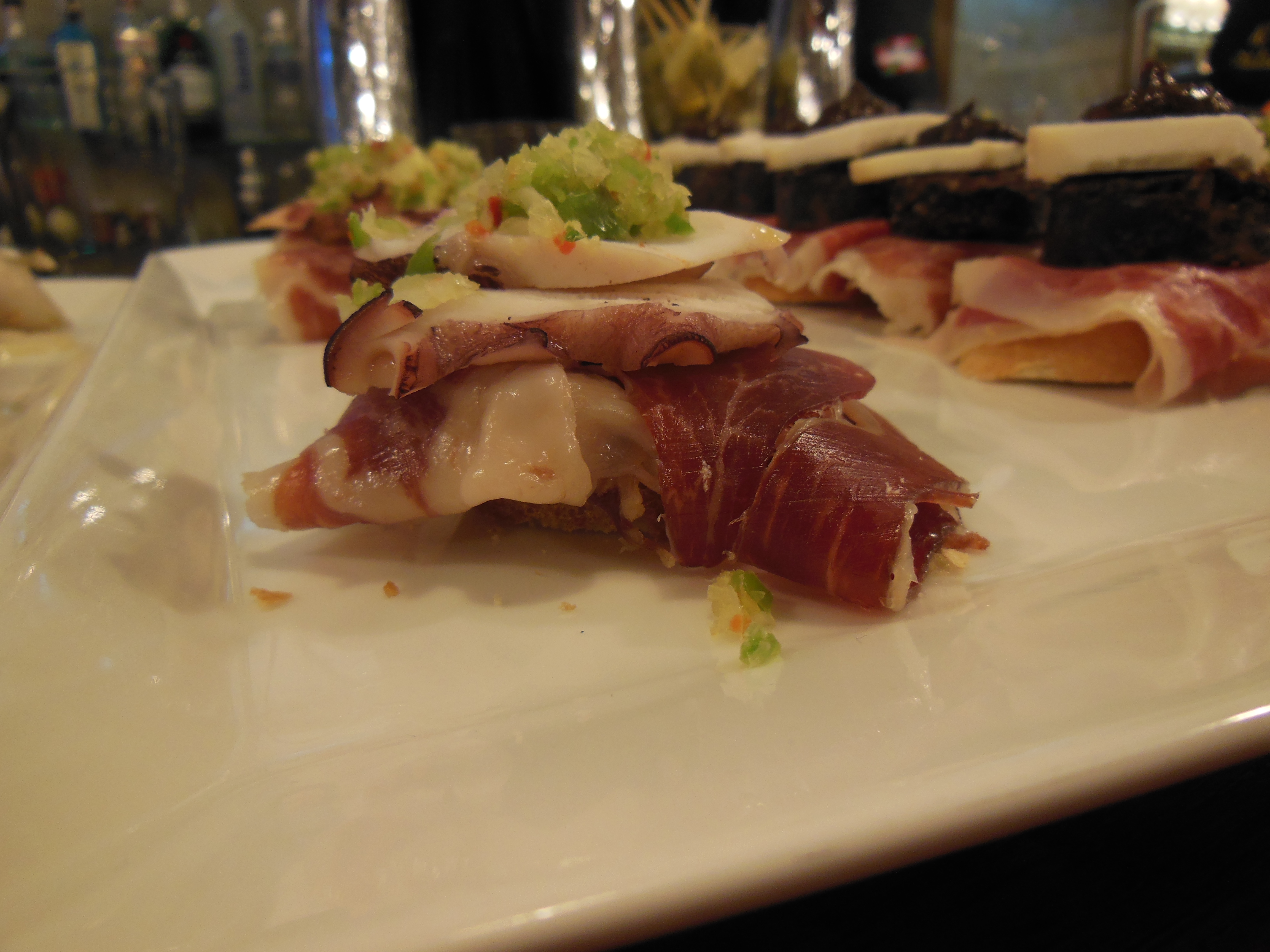
9.) PINCHO/PINTXO – Yeah, yeah every schmuck and their hermano know about tapas by now, as just about every major American city has a slew of token tapas establishments. But, before ordering enough patatas bravas to clog up your arteries well and good, know that you might get straight up cold shouldered if you mention tapas anywhere north of Madrid. Originating from the Basque Country, pinchos are the equivalent of what would be referred to as a tapa in the south,  though they are bigger and come at a fee unlike their complimentary, southern cousins. It all depends on where you go, where the chef is from and if they want to give you a hard time, but at the risk of sounding like a goober, just be aware there is a difference between the two.

Typical Spanish Pintxo in San Sebastian, Spain

10.) NO PASA NADA – If England has “God save the Queen,” Spain has “no pasa nada.” This phrase sums up the general attitude of many a Spaniard, and it is nothing short of fantastic. Late for class? No pasa nada. Break a glass in the kitchen? No pasa nada. Exams? No pasa nada.  This often becomes the gospel for study abroaders in Spain as they slowly become entwined (and rightfully so) in the wonderful whimsy of wanderlust.

Appendix: 

-Pasta – NOT Barilla. Often used to refer to dolla dolla bills.

-Majo/maja – Adjective used to describe a genuinely nice, goodhearted person (or just good-looking).

-Guay/chulo – Synonyms: Cool, awesome, neat-o.

-Resaca – Undertow, er, I mean, you can figure it out.

Well there you have it. This list is meager to say the least, but hopefully it will help break some of the ice and make you stick out more like a sore pinky or ring finger as opposed to thumb. Also, if this was too PG for your liking or you just have natural pirate-like tendencies, go to your local urban outfitters and get this – but remember just because it’s in Spanish, doesn’t mean you’re not a potty mouth.

Quincy Snowdon, DUSA Blogger