
Intercambios Saved My Spanish

After more than a month in Spain, I have a new level of respect for anyone who decides to move to a country where they will have to speak a different language. Even the simplest sentiments can be difficult to translate. Oftentimes, it takes me about twice as long to say the same sentence in Spanish as it would take to say it in English. Sometimes I hold up my hand, say “espera,” and take a minute to search for the word I need. And every once in a while, after staring into space for far too long, I sigh and say, “no importa.”

Though I try to practice as much as possible, it hasn’t been as easy as I expected. Originally, I imagined myself speaking Spanish all the time once I got off the plane in Madrid but it soon became clear that our program coordinators were going to communicate with us almost exclusively in English. Whenever I was hanging out with other people in my program they spoke English too. After a couple weeks I felt myself comfortably slipping into speaking English whenever I could, which was often, considering all my friends were Americans from our program.

Wait, I would think every so often. This isn’t what I came here to do. It felt wrong to only ever be speaking in Spanish when I was with my host mom or in class. Wasn’t I supposed to be trying to immerse myself in this new language? At the same time, I didn’t want to ask my friends to try to have Spanish-only conversations with me, and I really did not want to attempt to ask a native speaker if they ever wanted to chat. I’ve played out the scenario in my head, and the only way it ever ends is badly. So badly. And awkwardly.

The perfect solution to my problem came a few weeks after we started classes: an intercambio. In Spanish, the word intercambio means “exchange,” and in this instance the exchange is vocal. Our university matches us up with a native Spanish-speaking university student who wants to practice speaking English and, once we’re given their contact information, it’s up to us to set up a meeting and start practicing.

Intercambios are the best thing to happen to my Spanish conversational skills since the Spanishdict app. I’ve met with many of my friends’ intercambios as well as my own, and they are all extremely friendly and speak near-flawless English too boot. They help you with your grammar mistakes and teach you slang that varies from the useful to the, well, less-than-appropriate.
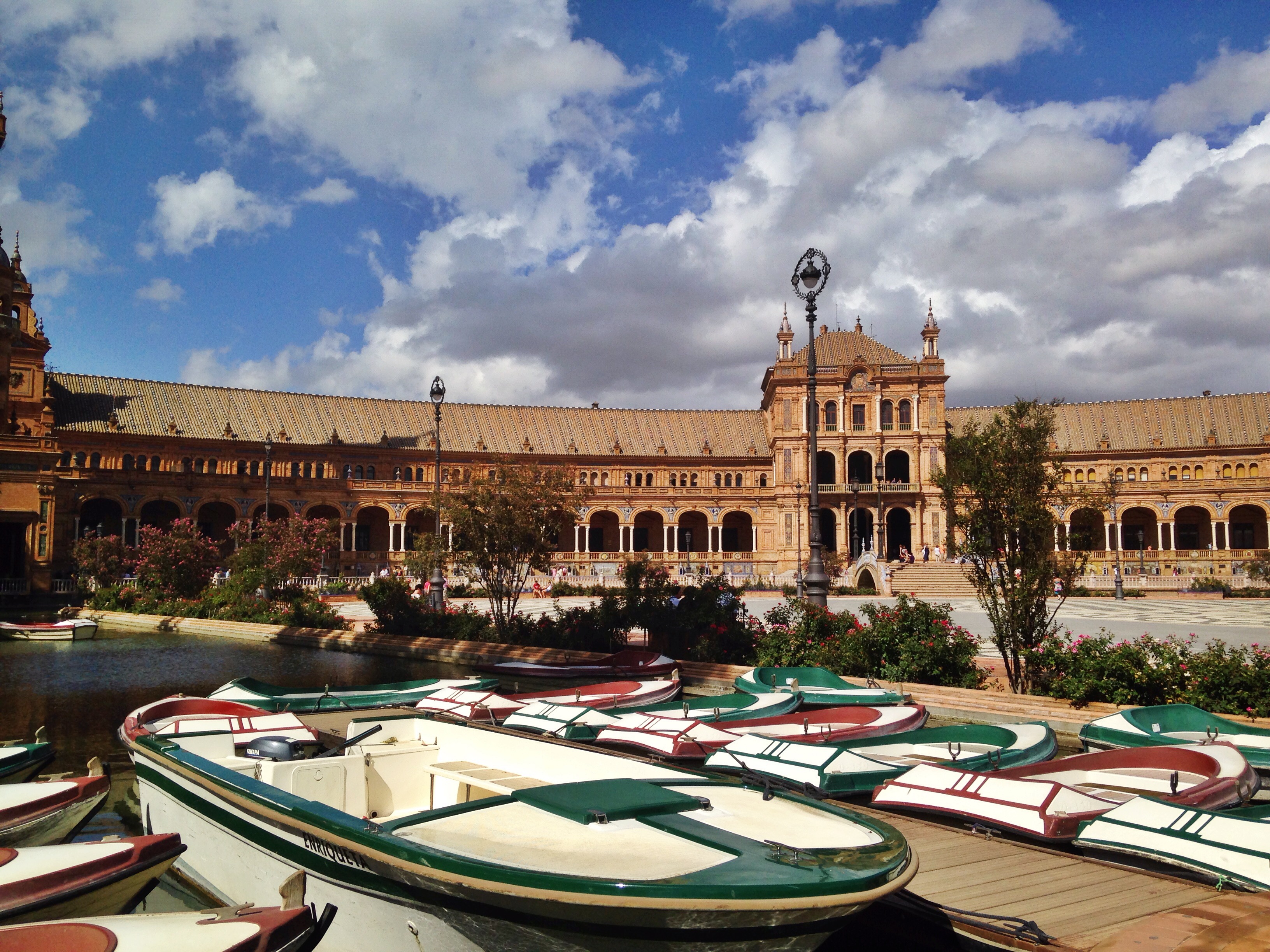
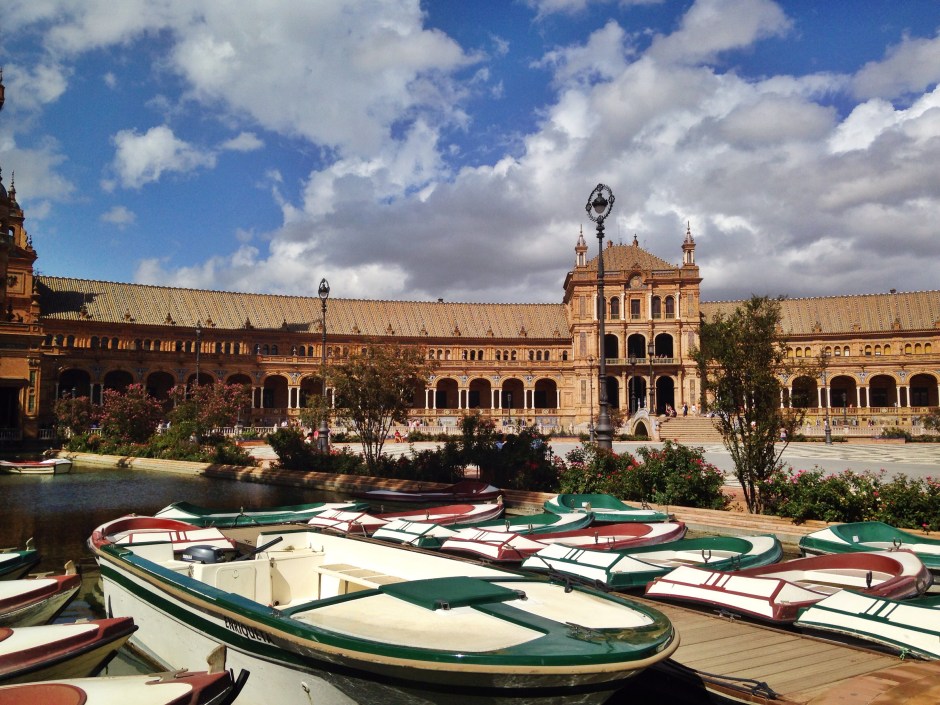
One of the sights I saw while exploring Sevilla with my intercambio - Plaza de España
One of the sights I saw while exploring Sevilla with my intercambio – Plaza de España

The other night I had my first dinner out where it was just me with my intercambio and her Spanish-speaking friends. To say the least, it was intimidating. Not a word of English was spoken. Many times I ended up grimacing because I wasn’t sure if I was supposed to react with surprise, disgust, or happiness. The pace of conversation was so fast that whole minutes passed with stories flying over my head as constantly nibbled on my food to make it look like I had a reason for my silence. Every once in a while, my intercambio would turn to me and translate a story that had just passed, rapid-fire and full of slang I don’t know, between her two friends.

Though the experience may have been a little bewildering, it was fulfilling in a way that spending a night speaking in English wouldn’t have been. I felt like, though I struggled, I was accomplished in some way.

And the things worth accomplishing, the ones that leave us with a sense of pride after we’ve achieved them, are the ones that present the hardest struggle along the way.
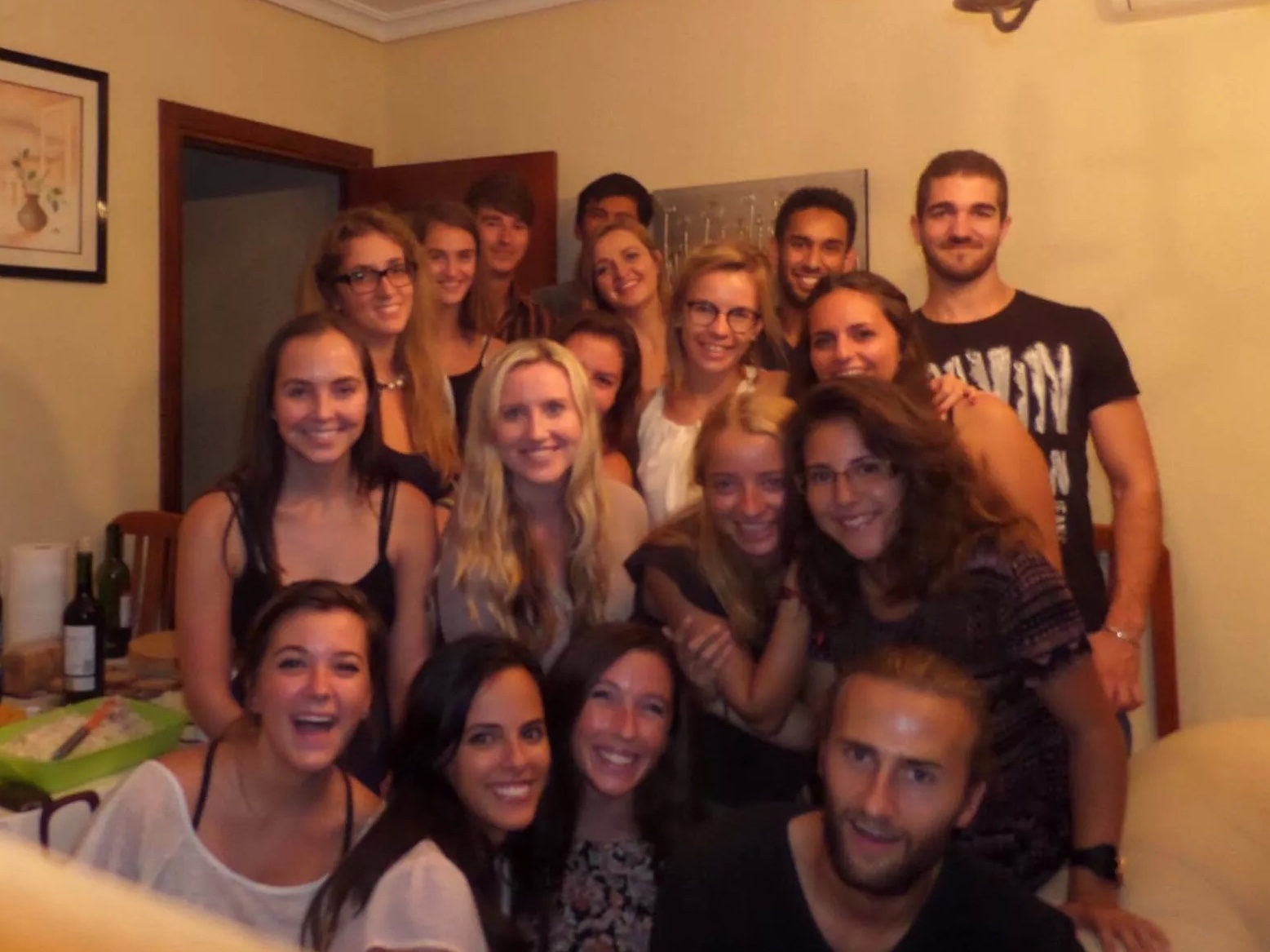
Intercambio night! Spaniards, Americans, Brits, Germans, and more.

To help with navigating the struggle that is overcoming the language barrier, I’ve compiled some facts/ tips that I’ve picked up in the last month and a half:

  • You will be scared. Don’t be. Nervousness may keep you from saying something wrong, but it will never allow you the chance to learn how to say it right.
  • (Most) people appreciate your efforts. Speaking in a country’s native language shows an appreciation for the people and their culture, and you are more likely to run into people who will help you through a conversation than people who will judge you for your mistakes.
  • Learning a language takes time; progress may seem slow, but as long as you keep practicing it will happen. Everyday phrases will become easier when you actually start using them everyday.
  • Sometimes the only reason you understand what people are saying is because of the accompanying hand signals they make.
    • Just today I had an entire conversation with my tapas professor using hand motions and sounds to imitate what food would sound like in the pan. Seriously. (And it was probably the most entertaining conversation I had all day). You can get by even when you don’t have the words to, so don’t get flustered when you can’t figure out what you need to say.

Emily Laurinec-Studer, DUSA blogger

The Good, The Bad, and The Different

Judging by the first two weeks I’ve spent in Spain, I will feel like I have packed in a whole lifetime’s worth of experiences by the time my three and a half months here are up. Time here feels contradictorily fast and slow – while two weeks has felt more like a month, I’m already lamenting the fact that I didn’t decide to study abroad for a whole year.

The feeling that time has been warped is due in part to how busy I have been. While at home I’m more apt to pass up activities in favor of relaxation, here I have been embracing the “you’re only here once” mentality and have therefore had days that never seem to end (but have taught me that I hit my limit somewhere around 4:00am). When days last that long and almost every moment is full, some experiences are bound to be less enjoyable than others. Sometimes I feel excited by new things. Other times, I just feel alienated. Whenever I start to feel overwhelmed, I try to keep in mind something one of our program directors told us on our first day here: “No one’s culture is good or bad, or better or worse than another – they’re just different.” Reminding myself of this from time to time helps alleviate the unavoidable awkwardness that comes with learning different customs and a different language. Bearing this in mind, I have tried to categorize some of my experiences thus far into three categories. First, I’ll list ones that have been truly good. Second, the truly bad. And third, the “different” – experiences which are both good and bad in turns and which I will eventually come to embrace as simply new realities that shape my life here.

The Good (+)

  • Siestas
    • Okay, so maybe I’m still bitter that they cruelly took away naptime from us post-Kindergarten, but I’m strongly in favor of the semi-official 2-5pm naptime that Spaniards have built into their schedule.
  • Excursions/Activities
    • In the first week, whenever I started feeling homesick and I went on a tour with my program, I instantly felt better. The historical sights are so beautiful and interesting that you can’t help getting caught up in the moment.
    • As a plus, these excursions allow you to meet all the great people you’re studying abroad with! Bond while exploring a new city and taking all the same tourist-y selfies.
Beneath "Las Setas," the largest wooden structure in the world built in one of Sevilla's plazas. Under it there is a fresh market and a museum that has preserved the ancient ruins (dating back to the Roman empire) Las Setas were built upon.
Beneath “Las Setas,” the largest wooden structure in the world built in one of Sevilla’s plazas. Under it there is a fresh market and a museum that has preserved the ancient ruins (dating back to the Roman empire) Las Setas were built upon.
On top of "Las Setas" - a beautiful view of Sevilla. One of my favorite excursions I've gone on yet!
On top of “Las Setas” – a beautiful view of Sevilla. One of my favorite excursions I’ve gone on yet!

The Bad (-)

  • Lost Luggage
    • The first day we arrived in Seville, one of the host families mistakenly loaded a piece of my luggage in their car. I realized how dependent I am on my laptop after three days without it.

The Different (+/-)

  • Walking/Transportation
    • You walk almost everywhere in Spain, which can be a good workout. (+)
    • If you walk too much your feet will hurt, you will get blisters, your ankles will get swollen, and you’re going to have to get up tomorrow and do it all over again. (-)
    • My university is outside of the city (as in, it’s in walking distance of nothing) and unless you feel like biking on the highway you have to pay to ride the metro every day. (-)
    • The metro is new and efficient, and the ride can actually be nice if it’s not too crowded. (+)
  • Clothes
    • The typical Spaniard dresses with much more flair and general effortlessness than the typical American (read: it’s possible yoga pants don’t even exist here). So, you will either end up blatantly sticking out as a foreigner (-) or you’ll have to go shopping (+)
  • Money
    • Spain is cash-based – it’s rare to pay with a credit card (and it’s a hassle if you don’t have the microchip that is standard in Europe). Using cash is a bit more complicated experience, especially when the denominations are different from what I’m used to. (-)
    • The euro is valued more than the dollar, which basically means that once I came to Spain and exchanged my money I was poorer than I was in the US. (-)
    • However, paying in cash also helps to keep me on a budget. It’s a lot easier to keep track of how much I’m spending when I can physically see how much I have left every time I look in my wallet. (+)

This is only a brief look at what my life in Spain has been like, and so far I can say that the good points definitely outweigh the bad. The cultural differences are starting to feel like they are just that – different, new, exciting, though at times overwhelming. Every day I am so glad to be here, to be absorbing a new culture, and to be learning how to adjust to the many nuances it holds.

Emily Laurinec-Studer, DUSA Blogger