Making It Feel Normal

The “vacation” portion of my study abroad experience has sadly come to an end. I’ve just hit my first week of real classes, and after a not so peaceful course registration, I’m glad it’s over. Before all this, I thought I’d known the true depths of how difficult registration can be. Back at DU, failing to enroll for classes which are vital for your degree happens to almost everyone at least once. But, after having to learn and use multiple different course-lookup software, navigate three separate registration windows, and try my luck on a completely random lottery-based class enrollment system, I now realize that DU isn’t so bad after all. Well, after all of that, and after dropping my Japanese level because I’m not nearly as good as I thought, it’s over. At least it turned out okay. A few of my friends weren’t so lucky and accidentally signed up for classes held at Doshisha University’s other campus, an hour train ride away. No, they aren’t able to fix them. For me, I’m finally in a good position to relax and settle in. With this, the daunting reality of just how long I’ll be here for has been becoming increasingly apparent. Japan will be my home for the next four and a half months, and honestly, it’s scary. I’m the type of person who can never undervalue the importance of comfort. No, I don’t live inside my comfort zone, but when all the fun is over, and it’s time to come back, and it’s just me alone, I want to feel at home. For the past week I’d been feeling more and more uneasy because I wasn’t feeling comfort when I needed it. I felt temporary here, and I started missing my home, an ocean away. But slowly, I started making changes.

I started by buying a bike, which, serendipitously, made me feel better almost immediately. Not only did I get a killer deal, and can race to school blisteringly fast, but I also regained a sorely missed sense of freedom. In Denver, I used to bike everywhere, and it felt good being able to quickly go wherever, whenever. Now, here in Japan, it feels even better. Kyoto is extremely bikeable, and I’ve found a lot of joy in aimlessly wandering around with no real destination in mind. Whenever I start remembering that home is 6,000 miles away, I hop on my bike, and suddenly, it doesn’t feel so far away. But really, how good I started feeling from riding my bike again gave me the idea that I don’t need to miss my home, I can bring it here.

My 35$ bike, which I have since added a basket to

Next, and least excitingly, I changed how I buy groceries. Stay with me now. I promise saving money is cool. Back in Denver, I’d walk into a Safeway with savings on my mind, and B-line it straight for the bargain section. Then, I’d wander around, crouching down and squinting at various price tags, comparing each item’s dollar per ounce value, until BOOM. A deal. I’d walk out of the store with a smile on my face and some extra money in my pocket. Since moving to Japan, I’d been doing all my shopping at convenience stores like 7-Eleven and tiny little markets, where I couldn’t build an understanding of how much something should cost, and what a “good” price even is. It was stressful knowing how much money I wasn’t saving. Having a bike helped with this, as I can now easily get to much larger supermarkets, like the ones in America, where I can penny pinch to my heart’s content. What can I say, I’m a frugal guy.

Wagyu steaks, which I can compare the prices of, if I wanted to

But then, with these extra stacks burning holes in my pockets, I had to find a way to blow all the money I’d just worked so hard to save, and the best way I’ve found to burn money like it’s nothing is to pick up an expensive hobby, and there are few hobbies more expensive than bouldering. For those of you who don’t know, bouldering is basically a more technical version of the climbing wall at your local rec center from when you were a kid, only more pretentious. I used to boulder 3-4 times a week before I came to Japan, and feeling a rocky shaped hole in my heart and a wallet that was just a little too heavy, I had to pick it back up. I’d researched ahead of time what the bouldering scene is like here in Japan, so I knew I was in for a challenge. The specific classifications and difficulty grading scales in Japan are simply brutal, and in the interest of not getting sidetracked, I will now take us off track to explain them in great detail. Bouldering problems are like tiny little puzzles. Constricted to only using certain holds, you must figure out a way to solve the puzzle and climb to the top. Boulder problems are graded using the V Scale, where V0 is the easiest and V17 is basically impossible. V0–V2 is beginner level, V3–V6 is intermediate, V7–V10 is advanced, V11–V13 is pro territory, and V14+ means you’re one of the best in the world, and if you can climb a V17, you’re one of only a few on Earth. A month ago, I was climbing V4s and V5s, which means I was an intermediate level climber, far from the skill ceiling, but a ways away from where I started. However, in Japan, the V Scale has been notoriously pulled back about four stops. Over here, I’m struggling to climb V2s. Among the more advanced climbers, the technical term for struggling on V2s is called being bad at climbing. But, although I’ve been humbled, I’m glad to be back on the wall.

Bouldering gym upstairs
Bouldering gym downstairs

Finally, and perhaps most importantly, I’ve started making Matcha tea again. I got really into making Matcha back home, and given that Matcha was invented in Japan, the best Matcha is made in Japan, and that the Matcha capital of the world is only 20 minutes away from me, it was only a matter of time. The only problem with Matcha is that it’s not as simple as steeping a tea bag for two minutes and calling it a day. Matcha is a real man’s tea. It requires elbow grease, finesse, and buying an unreasonable number of supplies just to be able to make it. Surprisingly, despite being in the Matcha capital of the world, reasonably priced supplies are hard to come by. So, penny pinching, I turned to something that we all know and love: Amazon. There’s nothing more comforting than wanting, finding, then having something, all without leaving your house. So, after collecting all the necessary instruments, and using extremely high-quality ceremonial grade Matcha, I finally made my first batch. Expecting something revolutionary, and with prying eyes of various onlookers (making Matcha can create quite a scene in the communal kitchen), I eagerly took my first sip. It was awful. Downright terrible. I had accidently bought what I suspect is called super-diet oat milk, which tasted just like pulverized cardboard. I’ve since bought tastier oat milk, and my Matchas are turning out much better. I’ve been having fun experimenting with different ingredient ratios and techniques, and I plan on taking a Matcha-making class while I’m here, for the ultimate wisdom.

All of my Matcha stuff
Finished Matcha

In the end, I realized how important it is to take care of yourself, and listen to your own needs. The person with the ability to make you happier than anyone else is you, so you might as well do it.

In other news, I also took a trip to Osaka with a few friends, and experienced numerous amounts of sweet delights. Here are some photos.

Osaka Castle
Cherry blossoms around Osaka Castle
A large eel
A couple of silly seals
My friend Jesse with the ducks
Osaka Aquarium open water tank
Jesse with the jellyfish
All you can eat wagyu, for less than 35$
Jesse with the wagyu

What My Study Abroad Program Didn’t Tell Me

As the end of my time here in Rome comes at full speed (23 days to be exact), my friends in my study abroad program and I have begun to discuss the ominous threat of reverse culture shock. We’ve had so many adaptations, so many lessons learned about how to “survive” in another country. Some of which I know I had to learn on my own, but some things which may have been useful to know going in.

Over the summer, the International Studies Abroad (ISA) program (through which I am here in Rome) sent us all a digital handbook containing information on everything from budgeting to that cultural adaptation graph I mentioned in a previous post. But there was also a section pinned onto the end about some specifics of living in Rome. Unfortunately, this merely scratched the surface of the subject. Granted, I’ve learned enough to fill a book with during my time here, and thus it would be impossible to contain it all in an already thick handbook.

Which is why I have compiled a short list for your own reading enjoyment containing some helpful hints to living in Rome that never appeared in the study abroad instruction manual.

1) “Non capisco l’italiano.”

Possibly the coolest and simultaneously most frightening aspect of most Italians is their carefree attitude. This means there’s no baristas being overly polite to suit your “customer satisfaction” needs (probably also helps that tipping your waiter doesn’t exist). Sure, they throw obscene gestures and shout curses at each other when they cut each other off on the road (see #3), but you know they don’t really care. I actually wish Americans could take a tip from the Italians when it comes to this. They freely their express anger, but they don’t let it bother them for the rest of the day. They have their bout of passion and move on.

Unfortunately, I eventually began to read this as Italians being unfriendly. But I realized how inaccurate this was after noticing how frequently random strangers try to talk to me. Even if it’s just asking me a question about where the bus is (see #2), it made me feel like I was finally blending in and at least looked like I knew what I was doing when they started talking to me.

Sadly, my single semester of “Intro to Italian Language” has not served me to the point of having the ability to carry on a full-fledged conversation with the fast-tongued natives. It can be rather intimidating when they confidently begin rattling off their fluid and musical words at a mile-a-minute. Which is why I was thankful that the only phrase I learned before arriving in Rome was “Io non capisco l’italiano” (“I don’t understand Italian”). Most times I can get by with just a smile, nod, and repeating “sí, sí” over and over again. But I’m still grateful that they’re trying to communicate with me.

Lesson learned: Italians are friendly, they just don’t care what you think of them at the end of the day. And that’s kind of cool.

2) “Scendo alla prossima.”

Public transportation in Rome is a nightmare, to describe it lightly. This is also a result of the nonchalant attitude but simultaneous passionate nature of the Italian culture. Apparently I was lucky this semester, since last year there was a bus strike at least once a week and during the entirety of finals week at my school (knock on wood). We’ve had a total of one day where the buses and trams shut down completely this semester, but even so, the buses are still notorious for disregarding the existence of a bus schedule. Case in point: it’s only a ten minute bus ride from my apartment to my school, but I still leave my apartment an hour before my classes start so I can make sure I catch a bus.

Image
“You guys might be there for a while.”

Once you actually get on a bus, there’s a certain etiquette to follow. First and foremost, there’s an almost surprising respect for the elderly in Italy. It’s customary that if an older person gets on the bus, a younger person will immediately offer them their seat. I’ve even seen raucous Italian preteens yelling, shoving, and generally wreaking havoc with one another, but promptly stop to get off the bus and help an elderly citizen hoist their baggage and/or groceries onto the bus.

Since the buses are frequently late, that means they can get crowded. I mean like sardines-in-a-can-crowded. I mean like disregard-any-notions-of-personal-space-crowded. I mean like I-hope-you-wore-deodorant-today-crowded.

Be prepared to shove your way to the door, but rather than wordlessly plowing through the mosh pit, it can be helpful to know the simple phrase, “Scendo alla prossima” (SHEN-doh AH-la PRO-si-mah) which means “I’m getting off at the next stop.” Even when it’s not insanely crowded, people will frequently ask you, “Scende alla prossima?” if you are blocking their way to the door. Remain calm (see #1) and answer “sí” or “no,” and move out of their way.

3) Pedestrians don’t have the right of way.

Image
Typical.

Back at home, in my quaint little suburban town of Louisville, CO, and even the (comparatively) bustling city of Denver there seems to be a high regard for the rule of pedestrians having the right of way in all situations. This is not the case in Italy.

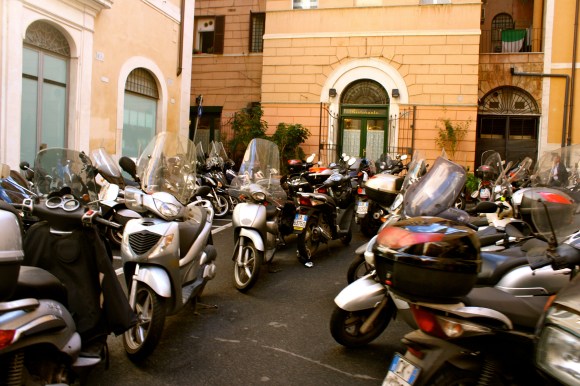
The roads are filled with smart cars and vespas taking advantage of their tiny size by zipping past each other at lightning speed. For not caring about being on time, Italians sure like speeding. I’m not sure I’ve seen a single speed limit sign while I’ve been here. Which is why the idea of slowing, let alone stopping at pedestrian walkways is utterly nonsensical.

Thankfully, those tiny vehicles and their drivers do have a fast reaction time, so if you do walk out in front of an oncoming one, they will stop, they’ll just be sure to stop as close to your feet as possible to give you a good scare. Still, most locals don’t seem to risk crossing the street at an intersection until the pedestrian walk signal gives them the OK.

Oh, and I’ve never heard so much honking in my life.

4) Fare la spesa (To go shopping)

I didn’t expect something as simple as grocery shopping to be such a different experience, but of course, studying abroad doesn’t miss out on changing your perception of anything.

I’m used to pushing a large cart around mega-Safeways and ultra-Targets, collecting as many items as will fit in the back of my car. But here, most folks walk to and from the grocery store, using little wheeled bags to transport their newly acquired goods home. Rather than using large push-carts, the grocery stores have little baskets that you wheel behind you, like a travel suitcase. I quickly learned that if the basket is getting too heavy to pull, that means I’m probably not going to be able to carry it back home.

As I’ve mentioned before, the grocery stores are nothing like the ones back home. They are much smaller and carry totally different items. For example, there are entire separate aisles devoted to pasta and wine, but I can’t, for the life of me, find baking soda.

Also be prepared to bag your own groceries. And try to do so quickly.

5) You’re going to become a coffee addict.

Image
Don’t fight it: reciprocate the coffee love.

Although I was a frequent indulger of coffee before coming to Rome, three of my best friends here had never tasted coffee or simply didn’t like it before their arrival. Now, they need one every day. A fair warning to all my friends and family: I’m probably going to be a coffee snob when I come back.

Nothing can quite compare to the perfect temperature of the coffee and steamed milk and the fluffy foam that sinks to the bottom, allowing you to scoop it up with your spoon when all the liquidy goodness is gone. But above all, the gentle *plop* of the sugar when the foam gives way for it to sink into your warm cappuccino just can’t be compared. I plan on video recording that exact moment, so I may relive it while I choke down my skinny vanilla latte when I’m Stateside again.

Thankfully, coffee is a major part of the culture here. But the primary difference is that cafés with ample seating and a welcoming atmosphere for you to take a load off and work on your laptop or read a book for hours at a time are not frequently included. Going out for a meal is a social gathering, whereas stopping by a coffee bar seems to solely fulfill the purpose of topping off your caffeine meter. These two seem to be switched in American culture.

In fact, sitting at a café will often result in paying extra money. If you want to save the cents, remain standing at the bar. When you do pay, it’s often after you’ve had your fill and are about to leave. There’s a lot of trust that you won’t lie to the cashier about what you had.

But why would you want to lie to the people who just fed you the drink of the gods, anyway?

In conclusion…

There are many differences between your old home and your new home and there are plenty of pros and cons that come with those changes. The whole point of this study abroad thing is to make your own “lessons learned list” and grow as a person while you’re making it. So maybe there’s not a manual for living in X country. There’s not a manual for life either.

Chow for now.

-Cheyenne Michaels, DUSA Blogger-