
Wednesday we took our Mongolian language final. I may still have the vocabulary of a very small child, but at least I can tell you I rode a horse and milked a cow in four different tenses. Now that the language class has come to an end, I thought I’d share a few pearls of wisdom/random facts I’ve picked up over the last couple of months.
Since there are like three million people in Mongolia, and Mongolian isn’t spoken in any other country, I’m guessing most of you don’t know anything about the language. Which is good news for me, since it means that almost anything I write here will be at least mildly informative.
1. It really bothers me that I’m two months into my time here in Mongolia and I still don’t know how to say “please.”
Actually, scratch that, it’s not that I don’t know how to say “please,” it’s just that there’s no stand-alone word for it. There are more polite ways to say things, and less polite ways to say things. And unfortunately, the less polite, informal way of saying or asking something is usually less complicated than the polite, formal way of saying something. So I only ever remember the informal bits that make me come off a bit clipped and rushed.
2. In Mongolian, everything has a suffix.
Mongolian grammar usually involves slapping a suffix on a word to convey meaning. Examples – possession, as well as the words with, have, by, for, and please, are all expressed in Mongolian by putting a suffix on the end of the word.
3. When in the countryside, you can convey a surprising amount of information just by using vocabulary for various livestock species.
Example 1 – Someone says “sheep” and points to the southeast (“hun” is how you pronounce it in Mongolian). Clearly, this is an indication that your host dad has gone off to herd the sheep. He probably took the motorcycle and will be back shortly, say maybe 15 or 20 minutes.
Example 2 – Your host dad points at you, points at the clock, and then says “horse” (pronounced “mor” in Mongolian). Obviously, it is time to leave for language class. You will be taking the horse. Don’t be late.
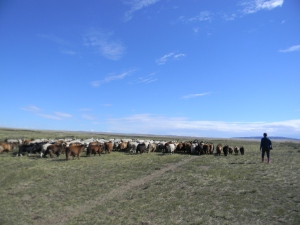
- Let’s herd some animals, ya’ll.

4. It really is worth trying to learn the language.
A couple of anecdotes:
Maybe about a month ago, a couple of my friends and I were walking near downtown UB, and we ran into an elderly couple. They were here on a mission for a couple of years, teaching English, and they didn’t speak a word of Mongolian. Towards the beginning of their trip, someone had told them that they shouldn’t try to learn Mongolian. They were there to teach English. Learning Mongolian wouldn’t be helping the students at all, in fact it might even be doing them a “disservice.” They took that person’s advice, and didn’t attempt to pick up any Mongolian, because, why bother?
Similarly, I was talking with my UB host mom recently (she’s speaks wonderful English) and she was telling me that on a recent business trip, she had been so surprised to meet an American who spoke seemingly perfect Korean. Why was she surprised, you wonder? Because, despite working with expats for several years at an NGO in Ulaanbaatar, as well as interning in New York for several months, my host mom has never met an American that speaks a second language, besides English. And you know what? She still hasn’t. Because the guy she met, the one who spoke Korean, wasn’t even American.
I’m not trying to make any sweeping generalizations here, but I think it’s safe to say that most Americans don’t prioritize learning a second language in the scope of their education. Which is really, really unfortunate in my opinion. And also unfortunately, I am a member of that category. Sure, I’ve taken Spanish classes on and off for five years or so, but I still have little more than basic proficiency.The process of learning a second language is so rewarding – just think how many more people you can get to know and perspectives you can be privy to.
You’ve heard of a bucket list, right? Well, I’ve had “gain fluency in a second language” on mine for about as long as I’ve had a list. And it’s time to put my words into action. One thing I’m taking from this trip is inspiration to redouble my efforts to gain fluency in a second language.
Because I think the importance of it cannot be understated. And because I’m all about walking the walk, not just talking the talk!
One year from now, I’d like to be able to look back on this blog post and be proud of the progress I’ve made becoming fluent in a second language.
What are your thoughts on the importance of learning a foreign language?
P.S. Here’s a picture of a ger, because this post doesn’t have enough pictures….

Also, check it out! Solar power! A lot of gers in the countryside have these little solar panels they use to power a light, the TV, etc. Pretty nifty, huh?
– Heather Cook, DUSA blogger


 DU Abroad