
Peñíscola- a Spanish seaside hidden gem

Driving down a long, flat stretch of highway off the coast of Spain, the earth was a burnt-sienna on either side of the road, with rows and rows of orange trees, all the way to the horizon. Where distant layers of hills met the sea, and sat in fog and mist, still not burnt off by the mid-to-late afternoon sun, we left Catalonia behind and crossed into Valencia. Known for oranges, and beaches, it truly lived up to its name.

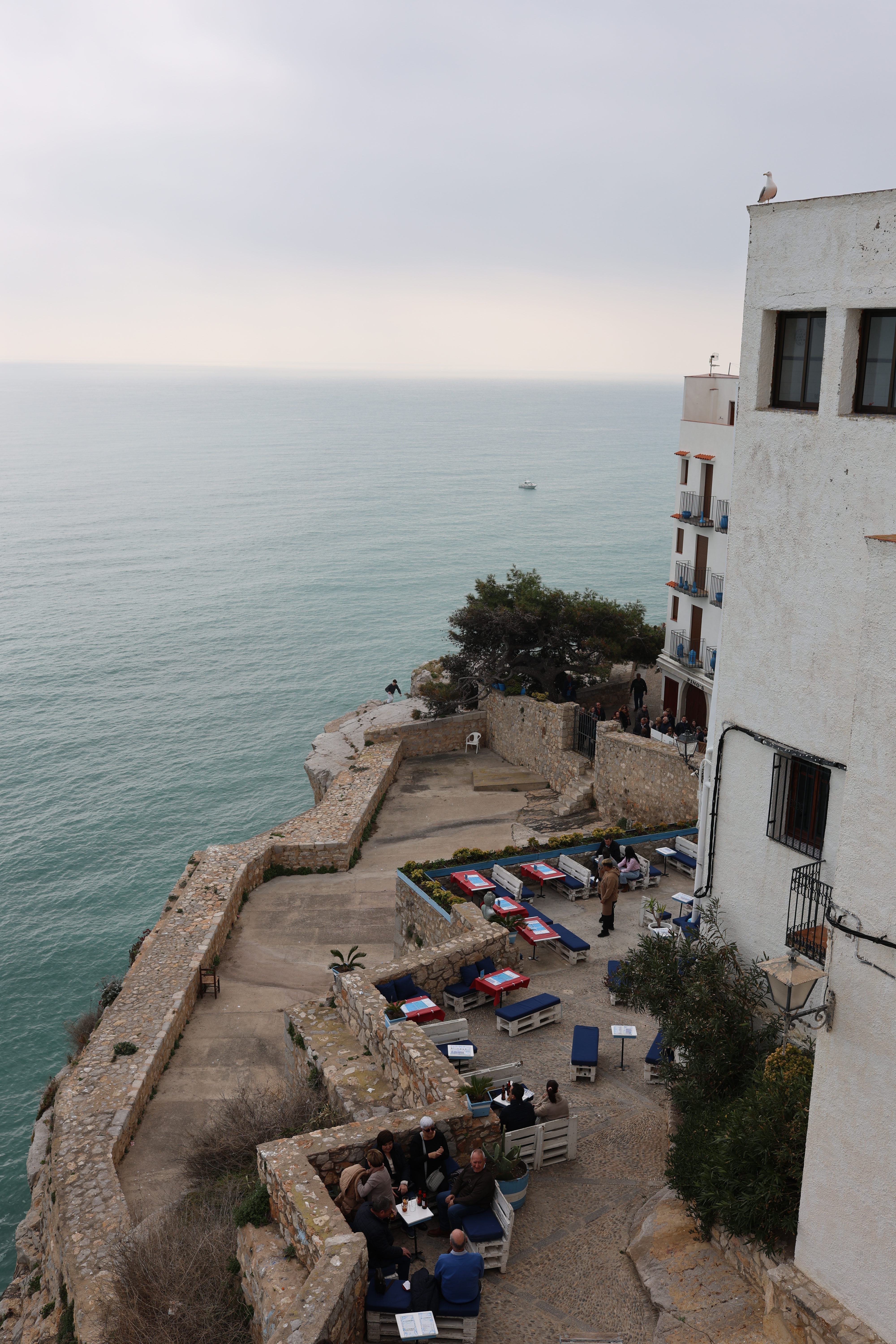
The past two weekends I was able to explore Girona for a day trip, Valencia for the weekend, and Peñiscola for the afternoon, with my program ISA. I have to say, Peñiscola stood out to me the most, and was my favorite by far. It had a certain speciality to it. Despite having visited various small, costal and even medieval towns in Europe, this small, historic city had a very unique feel. Peñiscola is exactly as you would expect from it’s name, a peninsula, surrounded by azure ocean, thanks to the white sand and beaches of the Valencian region. A small, fortified sea port, perched on a high, cliffy peninsula. Across the bay, hugging hills holding the Sierra de Irta natural park. It was a truly spectacular sight. The town, if you could even call it that, is nestled in the fortified walls, and is mainly composed of a large, yet simple fortress castle, and its grounds. My friend and I, along with the trudging 45 American ISA students, all bought a 3.50 Euro ticket to get into the castle atop the town (by far best value I have ever spent to enter into any attraction in Europe).

The cliffs that the castle was built on, was tall enough to make you step back and wonder if they should raise the stone wall overlooking them. Very impressive, to say the least, with how to town (and castle) was incorporated into the tall, rocky cliff of the peninsula island. The castle had the most wonderful views, with so many stone rooftops and narrow stone staircases offering a full 360 of the coast. It had been a completely cloudy, gusty day so far, but finally, when walking around the castle, the sun peaked out for a while. This transformed the water from a beautiful and deep teal, to an absolutely glowing aqua. If the sun had fully come out, I just know the entire ocean view would have been even more breath-taking and luminescent. Let’s just say that day, I thought I was going to fill up my SD card with the amount of photos I was taking.

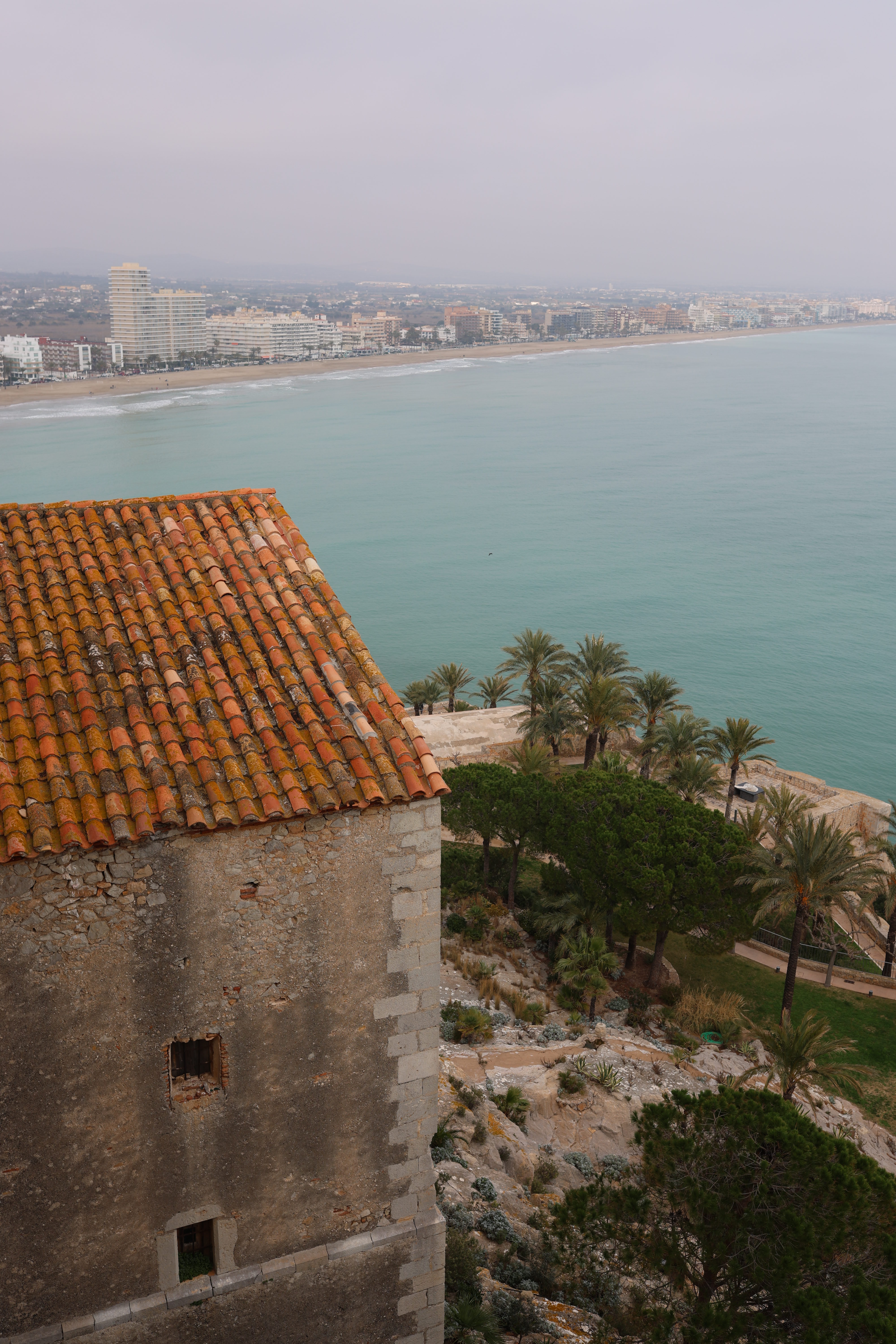
You could exit the castle and walk around to the castle gardens and grounds bellow, included in your ticket. That is when the sun came out again and the water showed off and shone. This vantage point from the garden was stunning, looking up at the castle, as well as across and up the cliffs. It also had a wonderful view across the bay, and the ribbon of the white sand beach, stretching all the way down the coast. There was a small city consisting of some high rises, solely lining the beach, and so many houses and buildings packed into the hills beyond. It looked like the Palisades… and the hills stayed moody and misty the whole time, with a low line of clouds laying lazily at top of the hills, among the houses.

The town itself was the quaintest, cutest costal town, down to every detail. From the white painted buildings, blue and teal doors, down to the flowered tiles that made all the balconies. The streets mainly consisted of wide, rocky cobblestone steps. Most all of the streets were lined with large potted plants, a lot of them in beautiful ceramic pots. Everywhere you looked was just so special, with so much care and details shown in little ways, building up a beautiful, costal town that looked straight out of a postcard.

The whole style and feel was very Grecian and so picture-perfect quintessential. One house was even entirely covered with sea shells, incorporated right into the white plaster of the house! It had a freshly painted teal door (matching the color of the ocean) and a matching sign which read ‘La Casa de las Conchas’, so it was quite literally ‘The House of the Shells’. I later researched and discovered that it was made around the ’60’s during the Spanish economic downturn, by a woman who was searching for a way to provide for her family. She set out to learn everything about the town, and sell her tips to tourists who were just starting to discover the town. She then turned this into a career, and became the first tour guide in the area. Her and her family built the three story house with the facade of shells, and opened a little gift shop. She adorned it in shells to show her love for Peñiscola and the ocean. It’s little stories like this that is the best part of traveling, and seeing the beauty and love put into special places like the Casa de Conchas.

The approximate three hours allotted to explore Peñiscola flew by, and even though I was so drawn to this seaside town, with artistic touches and history everywhere you looked, it was time to run back to the buses. There are only really a few entrances into the fortified town, I accidentally headed in a dead end direction. But this walk brought me into the quaintest, yet grand courtyard, with the Peñiscola style buildings, shutters, and plants, with the immense grandeur of the medieval wall looming above. Worth the accidental detour. All 95 of us American students poured back into the buses, and started our drive back to Barcelona.

The drive back to Barcelona after Peñiscola was like the PCH of Europe. Waves progressively rolling and crashing into the rugged coast, white and foaming, along the eroded rocky coast. The costal road winding above the rocky cliff, with nice standalone homes in the hills, facing the Mediterranean. We passed Sitges along the way, another well known costal town of the area. Small day trips like these are truly spectacular, and the Spanish Mediterranean is truly something special.

See my photos and get a good feel of the ISA weekend trip here! https://www.instagram.com/p/DGOMhm-OhONYvQ45d1Vbz_V-oCQrtKSFV1OEkA0/?utm_source=ig_web_copy_link&igsh=MzRlODBiNWFlZA==
Eurail & train pros & cons

A personal anthology of Everything Eurail. Everything I wish I knew before traveling around Europe by train (info that even TikTok won’t be able to help you with).

If you’re studying abroad in Europe, and want to travel as much as you can, you may want to consider the Eurail pass.

If you are currently a sophomore, or a junior reading this (and planning on studying abroad in the winter/spring, or even fall) Eurail pass does Black Friday sales. Which is absolutely worth it to buy in advance. It is a really good deal. You can buy your pass in advance, then you have up to a year to activate it whenever you want.

Here are some considerations and tips for choosing the best Eurail pass for you, and to help you decide if it is the right choice for you. As someone with a more limited abroad budget, it was absolutely worth it for me.

First, consider how close your host country is to the places you want to go. Or where you could travel to by train. For example, I was in Florence, Italy. I traveled around Italy by train, and to Slovenia, Austria, Germany, and took a train from London to Edinburgh/Belgium. As well as by train in the UK and the Netherlands. The train station was central in Florence, and easy to access, making trains a great, budget friendly travel choice.

If you’re planning on studying in the UK or nearby, I recommend the Eurail pass! Trains and transportation are VERY expensive in the UK. No matter the time of year. For example I traveled from London to Edinburgh, the train I took would have cost $150 for a 2nd class ticket. Which would be around 35% of my Eurail pass cost, but for just ONE trip.

Also consider how many trips you’ll want to take, and if you need to take high speed trains or not.

A great option for a semester abroad is the unlimited Eurail pass for 2 or 3 months. This is an amazing option for flexibility, budget, day trips and weekend trips. When you’re traveling by train in Europe , flexibility is KEY. It may seem like a lot up front. But it is worth it if you are going to be traveling every weekend (or almost every weekend). Plus it’s nice to get one travel expense out of the way. Take advantage of the Black Friday sale!

It may been intimidating or hard to know what Eurail pass to choose at first, but if you do some quick calculations you can decide which one is best for you.

For example, I had the 10 trip Eurail pass over two months. But I think the perfect pass choice would be 15 travel days over two months. Having the extra travel days for more flexibility and longer travel days is worth it.

Something else important to note, is the amount of months/days the pass will be valid for! If you want to spread out your trips, you definitely don’t want to do the limited number of days in one month. You will get a better value by doing the 10 or 15 days over two months, or unlimited. For example, I decided to extend my last trip by one day. But I forgot that my pass expired that next day. So when I got on the train I had to pay for a full ticket price, even though I still technically had a travel day left on my pass, it didn’t matter because my pass was expired.

Obviously Eurail pass is best for going location to location, not back and forth from one place (like weekend trips). However I was able to make it work no problem, and I really recommend it, as individual train ticket prices can be more expensive and change a LOT. Some people took 3-4 trains in Italy and it cost around the same price at my 10 day trip pass.

No one really talks about train strikes or warns you about them. Italy particularly, was a bit notorious for train strikes. I was not expecting them, didn’t know much about them, and wasn’t warned about them (even by my program in Florence). SO PSA: If you’re studying abroad in Italy and planning on taking trains, look in advance for train strikes. Most of them will be scheduled, but sometimes it’s hard to find specific information. Important lesson that I learned the hard way, if there’s a possibility or uncertainty of a strike, schedule around it. Or arrange backup plans. When I was in Italy, there were particularly many strikes, significantly more than other countries.

Other countries may also have train strikes. If you’re taking a train somewhere to/from a major city, check this before planning your trip. For example Netherlands, Germany, Paris, etc…

However this should not deter you from traveling by train, and you can easily avoid any issues by planning ahead.

Always book trains with at the MINIMUM 10 minutes between each other. But if possible, aim for 20-30 for transfer time. Most trains (especially regional ones can easily get behind schedule), and some train stations may be hard, or crowded to navigate. So most times you won’t even have to wait 1hr – 30 mins between trains, if you’re taking a regional train in any country.

A great pro of using a Eurail pass is having stop overs along the way to your destination! This is how I got to see multiple cities from just one trip/or travel day use. For example, I had a 6 hour stopover in Rome, a 4 hour stopover in Venice. So I got to explore them without using an extra travel day, or buying another ticket.

Lastly and most importantly. Travel days. Something I learned the hard way, is what was considered a ‘travel day’ for Eurail. I had to rework all my trips, and take more high speed trains, to try and just use two travel days for each weekend trip. This is a pro of the unlimited pass, you don’t need to worry about the number or travel days or taking late trains. But let me break it down for you:

When you get your Eurail pass you ‘activate’ it when you’re ready to take your first trip.

From that first activation, your month(ly) period begins. For example if you have a month long pass, and activate it on the 1st of September, it will expire on the 1st of October. Even if you don’t use all your travel days. So use your days before it expires!

You can choose what travel days to activate your pass on (if you have 10 or 15 travel days for example). You need to activate your travel day before getting on the train, or else you risk a fine.

A travel day is a period of 24 hours. Try to take trains earlier in the day to avoid having to use two travel days to get somewhere.

So let’s say you’re taking a train at 8pm, and then you have to take another train at 12am (you’ll need to use two travel days).

You need to activate your pass and get your seat reservations BEFORE getting on the train. This is how you avoid fines or not being allowed on. Some high speed trains only have a certain number of seats for Eurail pass holders. For example, when I was in Amsterdam I wanted to take a high speed train to Belgium, but it had been booked up for a month already because of this limited availability. Same with in London. And they were very strict on it.

Obviously taking trains takes longer than flying, but it’s also a beautiful way to see different countries. I only had two days of classes, so that’s how I was able to take longer train journeys. But even if you have class 4 days a week you can make it work. If you take night trains or high speed trains, it is possible to make a short weekend trip happen. Or you can use your pass for day trips explorations. Everyone should experience a train trip at least once on their abroad experience, especially since it is something we don’t have in the US.

I hope this is helpful if you are considering the Eurail pass for studying abroad, or at any point in the future!

Overall, I do recommend the Eurail pass if you’re studying abroad (in Italy especially), for flexibility, seeing MANY places around the country you’re in, and visiting countries nearby. It is a better rate than flying or buying individual tickets.

Happy travels! 🙂