
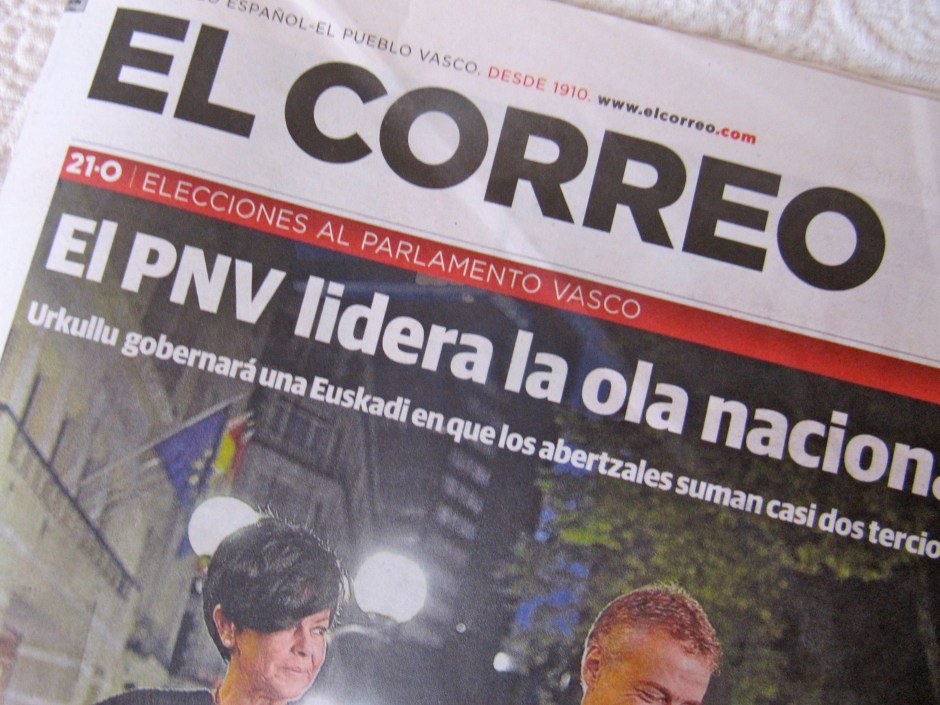
One of the first things that attracted me to the idea of studying abroad in Basque Country was their long and controversial history of nationalism. At once, they are a society that is fighting to fit into the rest of Spain, and fighting tirelessly against it.
Nationalism has become a sustained thread of interest for me throughout my time in Bilbao. It pops up in classes, in the news, in conversations, in ways that I wouldn’t have expected. I’ve heard the entire spectrum of opinions, from those who are strong supporters of Basque separatism, to those who regard it as something dangerous.
That is why I was so pleased to be present for the Basque Country’s regional elections this past Sunday. I had the opportunity to witness first-hand the democratic process in a region that struggles with it’s definition of statehood. I hoped that the results would be telling of the majority’s attitude towards Basque nationalism and, more importantly, the direction in which the region hopes to travel in the future, politically speaking.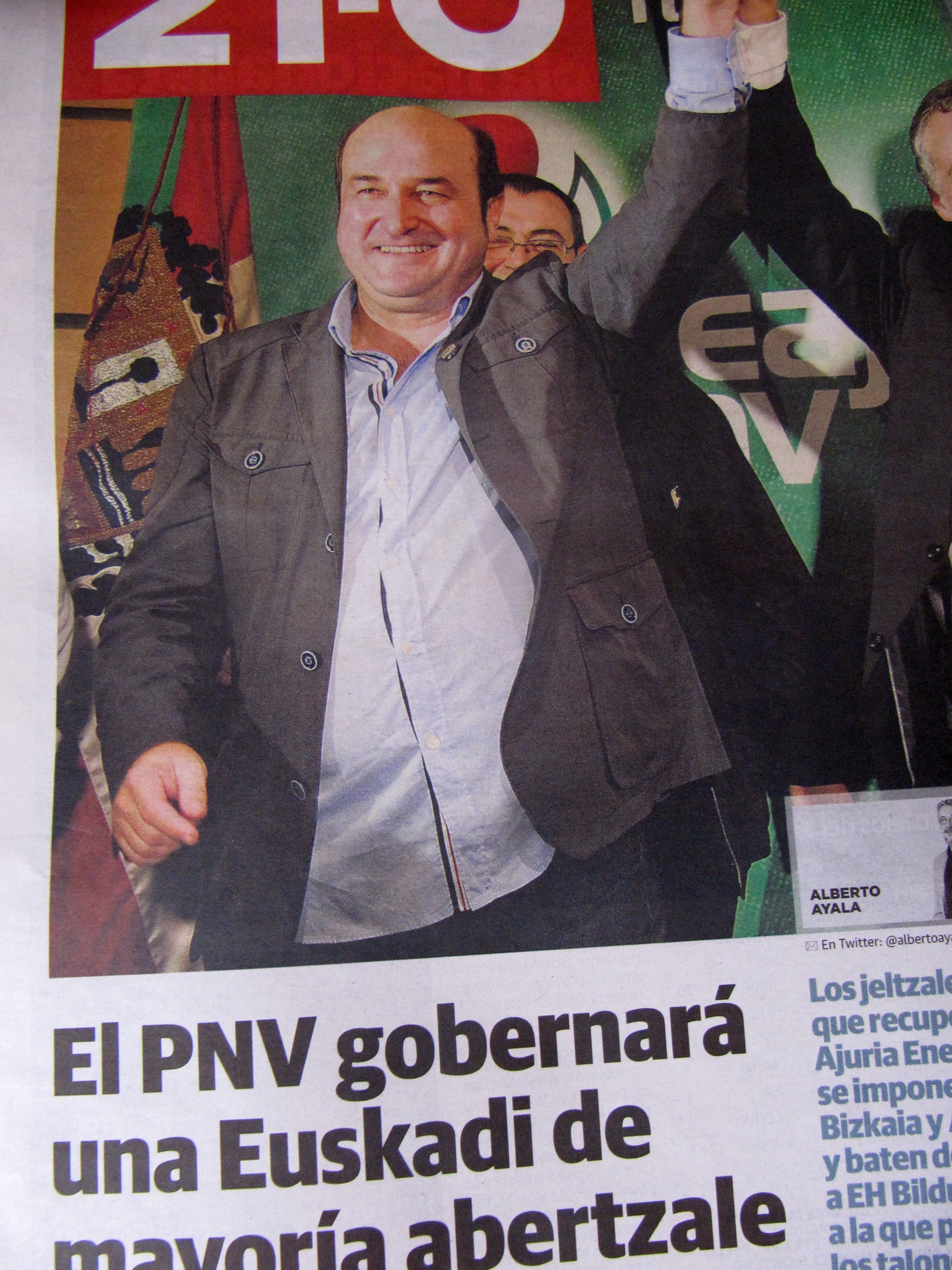
These elections had a special significance.
First, they were held in light of the renewed and growing independence movement in Cataluña. The Basque Country and Cataluña are often thrown into the same hat, since both regions are identified as something slightly separate from the rest of Spain. Both regions have their own unique languages and cultures that many of their inhabitants recognize as their true identity. The current conservative federal government, headed by Prime Minister Mariano Rajoy, has been nervous about the independence movement in Cataluña, concerned that it may spark similar movements in other autonomous communities, particularly the Basque Country.
Second, this is the first election to be held in the Basque Country without the looming shadow of ETA. The Basque terrorist organization declared a permanent ceasefire and cessation of armed activity one year ago. This has been the Basque Country’s first exercise in the democratic process without fear of violence. This is a political victory for all Basques, nationalist or no.
However, nationalist sentiments, or those opposed, where not at the forefront of this election. Like the rest of Spain, citizens of the Basque Country were most concerned with the economy.
The last regional government of the Basque Country was lead by Partido Popular, or PP, Spain’s most prominent conservative party. This was the first Basque regional government not to be lead by a Basque nationalist party, such as Partido Nationalista Vasco, or PNV. Unfortunately for PP, the economic situation that hit Spain since the last regional elections shed a rather poor light on their leadership. There was no doubt that PP would not be receiving the majority vote this time around.
Like most elections past, PNV was the political favorite. PNV is marked as a left-leaning nationalist party, though strongly opposed to ETA. Historically, PNV has preferred increased autonomy to outright independence from Spain.
 The party that people were holding their breath over was Euskal Herria Bildu, or EH-Bildu. It is a leftist, Basque nationalist and separatist party, newly formed from a coalition of smaller separatists parties in San Sebastian last July. EH-Bildu has gone by a variety of names in the past, partly from a recurring need to revamp their identity. There is a long-running connection between members of EH-Bildu and ETA. For this, the party, then called Batasuna, was refused participation in the 2009 regional elections by the federal government of Spain. The coalition was allowed participation in this year’s election thanks to ETA’s ceasefire. Nonetheless, EH-Bildu still makes many citizens of the Basque Country nervous.
“They say they aren’t associated with ETA anymore, because of the ceasefire, but I still don’t trust them,” my host mother, Julia, told me. Her doubts are not unfounded. Members of EH-Bildu erroneously denied their connections with ETA multiple times in the past. Whats more, ETA has declared ceasefires more than three times in the past, only to see them broken. It is still too soon for some to trust EH-Bildu’s peaceful intentions.
However, on the other side of the line, the strong support for EH-Bildu is not a surprise for many Basques. Certainly, there are citizens of the Basque Country who support EH-Bildu’s independence policy, but more importantly, they support EH-Bildu’s important role in ETA’s peace process. For this, among other reasons, many Basques expected the party to receive more votes. It certainly speaks in the election results:
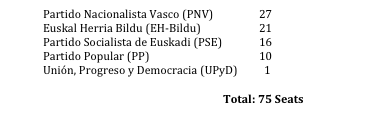
PNV came out with the greatest number of seats, with EH-Bildu trailing not far behind. No party won a clear majority, which requires a minimum of 51% of votes. Therefore, the two parties with the most seats in parliament, PNV and EH-Bildu, will form a coalition to make a majority. The coalition between PNV and EH-Bildu is being called Abertzale, which, loosely translated, is Basque for “patriot”. This election has resulted in the most nationalist Basque parliament in history.
While the current economic condition makes it highly unlikely that an independence movement rivaling that of Cataluña will spring up in the Basque Country any time soon, it will be interesting to see how politics, especially those surrounding nationalism, progress in the Basque Country in the years to come.
– Emily Bowman, DUSA Student Blogger 2012




 DU Abroad