
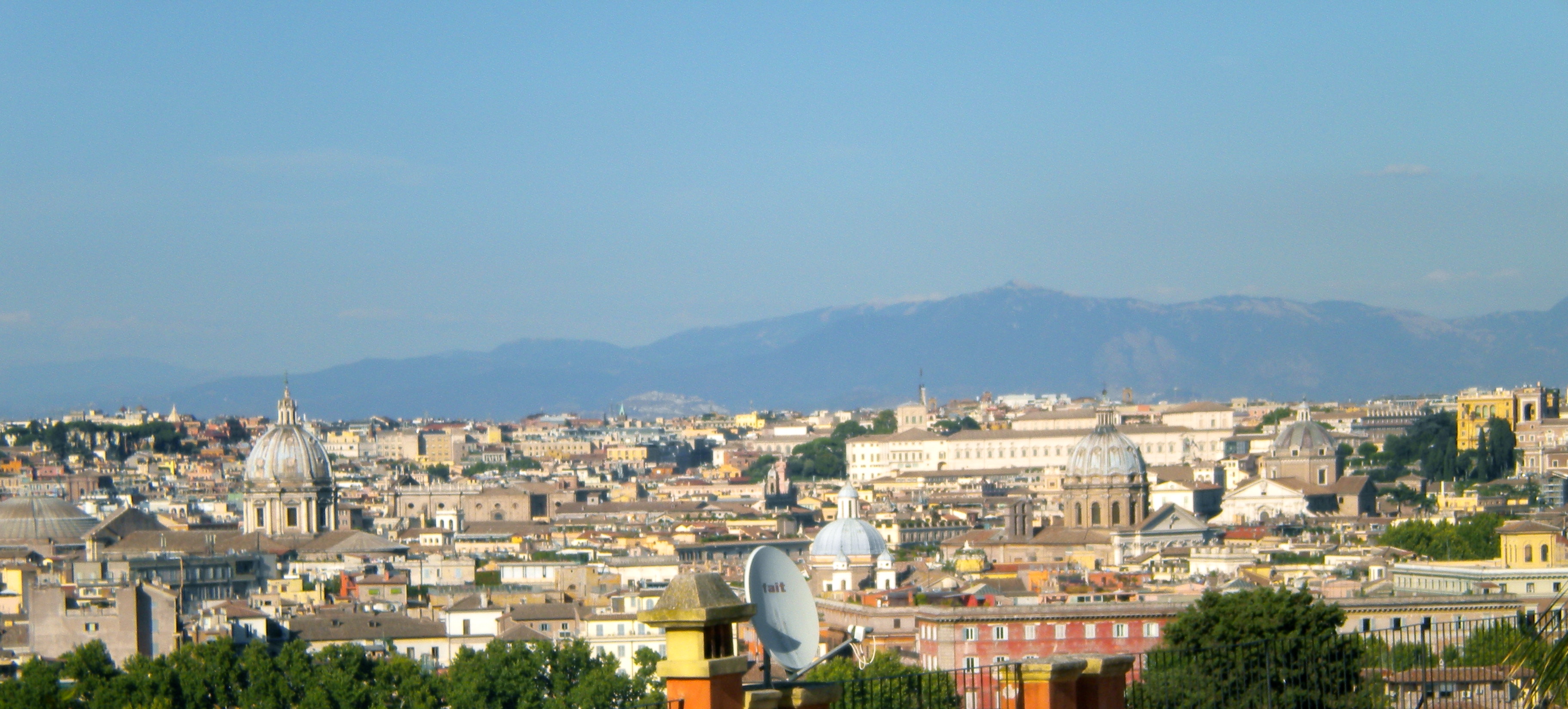
Il Dolce Far Niente

Ciao from Rome!

After many kitchen victories and mishaps at home in Colorado, having a mental breakdown as I was packing, 12 hours of delayed flights, non-sleeping in upright positions, single serving friends, a pair of overly hormonal seat neighbors on the plane, arriving an hour late and having a mini-scare of my checked luggage being lost, I have FINALLY arrived in the motherland of amazing food.

This whole week that I’ve been here has been filled with endless moments of awe, dream fulfilling meals, and language barriers and breakthroughs, most of which are described on my own personal blog in both word and picture form. If at all interested, check out on my blog, Italy in Food.

Tomorrow I begin my first day of classes at the American University of Rome: a quaint, small, beautiful private university tucked in between the trees and streets at the top of a hill on the edge of Trastevere (tras-TEH-ver-ay; translates to “on the other side of the river”). Students who go there are a mixture of study abroad students, Americans living in Italy, and born ‘n raised Italians.

Today being our last day of summer vacation, the roommates and I have been pondering what we would do on our “final day of freedom” for a while now. Originally, the plan was to escape the heat and wade in the Mediterranean Sea at the beach. This plan was cut short at the sight of the weather forecast for the whole week: rain, rain, with a side of rain. Our second choice was to wander around the Vatican, which is the only remaining touristy area we have yet to explore. The Vatican’s closed on Sundays. I walked into my kitchen after waking up at the early hour of noon to find my roommates on their laptops desperately seeking something for us to do. I threw out the suggestion of taking cover from the rain in a museum. No response. Eventually the roommates gave up their search and trickled away into their respective bedrooms, which meant we weren’t making plans for today. I took advantage of this non-decision to do something that has been far and few between for this last week since I arrived: relax.

After making myself some eggs, I found myself on our balcony with a cup of Earl Grey, watching the rain fall and re-reading “Eat Pray Love” (my bible and part of the reason I am here in Rome right now). I did this and nothing else for two hours. The only reason I came in was because I was dangerously approaching the end of the first third of the book (the portion when Liz is in Italy, a.k.a. my favorite) and because I couldn’t wait to tell all of you about how I did nothing today.

On the days when we are busily buzzing about from piazza to piazza or monument to monument, I often find myself homesick for being lazy. And that sounds terrible. But when my feet are throbbing and I’m sweating out every drop of water I’ve been chugging lately, I often yearn for the not so distant days when I could just sit on the couch with Boyfriend, watching Breaking Bad (our addiction). Or sit at the kitchen table with just my mom, a mug of coffee, and a magazine. During the school year, these moments are far and few between, which brings us to the second reason why I am in Rome this very moment:

I thrive on agenda–or at least so I thought until I started having health issues. I like to keep myself busy but there often comes a point, usually when I am standing chin deep in calendar alerts, full inboxes, mile-long to-do lists, and shrinking deadlines that my body comes to a halting stop and breaks, either in the form of illness or an anxiety attack.

This is why I am in Rome. To educate myself on how to thrive on nothing. To teach myself that I don’t need a full schedule to be happy. That I can meander around the streets of Rome with my new friends until 3 o’clock in the morning, stopping in the occasional bookstore or caffé to talk about our favorite books, movies, and musicals without a care in the world. Doing nothing is a way of life here. It’s a point of pleasure. Enjoyment. Sweetness.

As I sat on my patio in the rain, I came to the sudden realization of just how lucky I am.

Ciao for now,

– Cheyenne Michaels, DUSA Blogger –

The Rookie’s Guide to Tapas

Tonight, for the first time since I arrived in Spain, I felt like I was in Europe. And it was all thanks to tapas.

Earlier this week, our first week in Spain, some friends and I were keen to try some tapas, that all-important Spanish ritual of eating and drinking that seems so simple yet, somehow, the Spaniards have perfected to a near art. Oh, you can imagine the anticipation as we crowded into the center of a tapas bar that was just opening for the evening. That was short-lived. It only took us a hot second to realize that we had no idea what we were doing, and then scuttle back onto the street. How does one do tapas? We looked at each other quizzically, and decided to work the question over with some helado (ice-cream), which, incidentally, is never a bad idea in Santander, but that’s another matter.

For those of you who are new to the Spanish culinary scene, let me bring you up to speed.

WHAT?

Tapas are small plates of food, typically consisting of jamón (cured ham), queso (cheese), huevo (egg), patate (potato), or maybe some variation of pescado (fish) commonly piled on a slice of pan (bread).

That is the traditional variety, but some more “cutting-edge” establishments are serving up favorites from Latin America, including pint-sized burritos à la Mexico and Argentinean empanadas.

Something similar, often confused with, but slightly different from tapas is pinchos, or pintxos (in Basque). Pintxos are a bit smaller, or more delicate, and much more work intensive, with a lot of care going into details and presentation. The best are said to be found in San Sebastian.

WHEN?

Tapas are usually eaten either just before lunch (1 pm – 3 pm) or just before dinner (6 pm – 9 pm). The idea is for the light meal to hold you over until the appropriate dining hour arrives. This is especially nice for foreigners who are not used to the Spaniard’s late mealtime hours. The food is also meant to accompany your pre-dinner drink. A Spaniard would never drink on an empty stomach – they know how to hold their alcohol.

WHERE?

While tapas can be found at most restaurants, bars, and cafes in Spain, some establishments specialize in tapas.

Tapas can be found all over Spain, although they prefer the above-mentioned pintxos in Basque country. I hear that in Granada it is written into law that every round of drinks ordered must be accompanied by a free plate of tapas. I, for one, am intrigued.

WHO?

Friends and family go out for tapas in groups of three or four. This is because tapas are typically eaten standing at a counter or gathered around a small cocktail table – there’s simply no room for more!

HOW?

Now let’s get back to the million-dollar question: How does one do tapas?

My friends and I chose to solve this riddle by asking our professors to recommend a nice tapas place for first-timers like us. Maybe they would come along and show us the ropes? Our simple request for a nice place to eat culminated into a verbal ping-pong match between our two professors (it was quite exciting) with the end result being that tapas should be included in our curriculum. ¡Vale! That was an unexpected, but very welcome outcome. (All the same, my friends and I considered ourselves muy suerte (smooth) for getting the ball rolling on that one.)

So, the next evening, after touring the Catedral de Santander to appreciate the various examples of roman, romantic, and gothic architecture found there, our class of twenty stood in the drizzle on a street corner while our professors spoke just above the sound of city traffic to communicate to us the ritual of Spanish tapas. As you can imagine, we were all a bit mystified. Soon we found ourselves trailing the streets among the Spaniards in search of our first tapas experience. This is what we found:

Tapas is something akin to a moving cocktail hour (or two). You travel with your group from restaurant to bar to etc.

The norm is to visit three places in an evening. At each locale, every member of your group samples one or two tapas and a drink (the Spanish drink of choice is wine). While everyone orders one tapas a piece, it is understood that each tapas will be shared amongst the group.

Tapas are customarily ordered at the bar. There will be a crowd of people instead of a line, so be prepared to jump in when you are ready to order. There may or may not be a menu. If there is no menu, then you may choose from the tapas that are on display on the counter. Either way, try to know what you want to order before the server gets to you. Neither the server nor those waiting behind you will appreciate you taking the time to peruse what’s on offer. Oh, and one person orders for everyone in the group. Don’t be nervous if you aren’t sure what to order. I’ve asked several Spaniards what their favorite tapas is and every single one of them has reported, “They’re all good!”.

To pay for the bill, everyone throws about 5 Euro into the proverbial pot. This will cover everyone’s drink and tapas. Nobody is allowed to count out who-owes-what. If you do not partake in a round of tapas, you do not need to contribute to the bill at that establishment, that’s fine.

But please, above all else, take your time and relax. It is tempting and all too easy to finish off a quick tapas in a few minutes – but don’t. A good way to slow down is to watch how much is left in your glass compared to what is left on your plate: is your glass half full but your tapas nearly non-existent? Then now would be a good time to take a breath and enjoy. Watch the scene around you, or indulge in some conversation – you know what to do.

Tapas is simple, and Spaniards understand this. And that, dear reader, is the beauty behind the art of tapas.

Emily Bowman, DUSA Student Blogger

Tapas sitios in Santander (recommended by my professors, two locals) 

Casa Lita – Paseo de Pereda, in front of the monument to los raqueros

 Bodegas Mazón – Calle Hernán Cortés, close to the intersection with Casimiro Sainz

Cañas, Vinos y Tapas – Calle Hernán Cortés, close to the intersection with Lope de Vega

Días de Sur – Calle Hernán Cortés, close to the intersection with Lope de Vega

Cervecería Cruzcampo – At the corner of Calle Hernán Cortés and Lope de Vega

Bodega Cigaleña – At the corner of Eduardo Benot and Emilia Pardo Bazán

Los hijos de Florencia – At the corner of General Mola and Eduardo Benot

La despensa – At the corner of Daoiz y Velarde and Pancho Cossio

Casa Ajero – At the corner of Daoiz y Velarde and Pancho Cossio

La Bodega Conveniente – In the Plaza Cañadío

Marcelino – Calle Pizarro, close to the intersection with Santa Lucía

Mesón Ramapalay – At the intersection of Gómez Oreña with Daoiz y Velarde; next to the Plaza de Pombo and the church of Santa Lucía

Café de Pombo – In the Plaza del Pombo

Luzmila – At the corner of Hernán Cortés and Marcelino Sautuola; in between the Plaza Porticada and the Plaza Cañadío

La Casa del Indiano – Inside of the Mercado del Este

Related articles