
“Never half ass two things. Whole ass one thing” –Ron Swanson
The wise and thoughtful Ron Swanson says this to his coworker, Leslie Knope, when she takes on too many responsibilities in the televisions show, “Parks and Recreation.” What Ron means is: commit yourself. Make your actions count for something. Take pride in what you have decided to do with your life, or even just your day. Never have I seen a group of people live by these words more than the Spanish.
The Spanish people have a passion and commitment within their culture enviable by the rest of the world. Every action is done with extreme thought and commitment. One of the most basic examples is their lunch. You cannot sit down at a restaurant in Spain for lunch and expect to be in and out in under an hour. You see, Spaniards take lunch very seriously. They will leave work and head either home or to a restaurant for a leisurely 2-3 hour lunch. Sitting and eating in their break room or worse, at their desk, is unthinkable. Many may see this as lazy, as it cuts time out of the workday, but I think the Spanish people simply refuse to half-ass their lunch. It is an important part of their day, within their culture, thus it deserves a couple of hours of full, thoughtful attention. Additionally, they have three different verbs that mean, “to eat breakfast,” “to eat lunch,” and “to eat dinner.” They have dedicated specific, individual verbs to each of these actions. Verb phrase will not do. This is a commitment to food. (I want to make it very clear right now that I am being very serious. Those that know me may think I am trying to make a joke or something here. I am not.) Lunch is important.
But the list of examples continues. For instance, printing in Spain can be a hassle so there have been a couple of time when I have had to ~handwrite~ my homework in a notebook and hand that in. Honestly the handwriting process was so bizarre, which is in itself, bizarre. But this is beside the point. I was out of practice ripping the paper out of my notebook and fully ripped my homework. I asked my host dad if he had any tape, which he did, and I watched as he very carefully cut the tape with scissors, when the little thingy that will cut the tape for you was conveniently right there on the tape dispenser. He then got extremely close to the paper as to tape the ripped piece perfectly back on. Then, instead of bending the excess tape over to the other side of the paper, he got the scissors and cut the extra tape off. Then he repeated this process three times, making the whole event take around five minutes. Five minutes to tape some paper. Look, I know this may seem silly, but holy crap I was just in awe. He refused to half-ass this tape.
What? I have more examples than tape and lunch?? Awehellzyah. Maybe the most obvious example is fútbol (soccer). Holy balls do
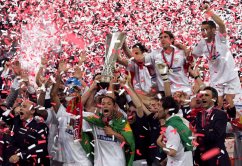
Spaniards love fútbol. I am studying in Sevilla and the more popular team here is F.C. Sevilla. I have seen F.C. Sevilla bags, scarves, mugs, cups, hats, bumper stickers, tattoos and so much more. I am living with a host family who fully supports F.C. Sevilla and I am literally not allowed to be anything other than a F.C. Sevilla fan. Lil history lesson for yah here: the Barcelona and Madrid teams have such an intense rivalry now because when the Spanish Dictator Francisco Franco was in power one of the ways to oppose Franco (without severe consequence) was to support the Barcelona team because Franco was a Madrid fan. They put their hearts into these teams. When the team wins, they win and when the team lose, their whole day is ruined. You never really encounter a fair weather fan here. Oh boy do the Spanish full ass their fútbol obsession.
Finally, in the south of Spain, the flamenco dance is extremely popular. It is Spain’s most famous dance as well as a symbol of Spain. I have been to two shows so far and am taking a flamenco class. So essentially, I’m a flamenco dancer. (I am not a flamenco dancer.) When you watch these flamenco shows, live or in a video online, the amount of passion that goes into each step is incredible. They seem fill their bodies with an incredible power, fueled with potential energy, then boom this incredibly fast foot

work paired with a soulful voice, full of emotion, hits the stage and it is the most enthralling thing to watch. Some of my friends got to sit front row at the Flamenco show we went to in Granada, Spain, and these dancers were so passionate about what they were doing, they rained sweat not only on themselves, but also on my friends sitting in the front row. I mean yucky, but it paints a clear picture on just how much of their heart and soul was getting poured into these dances. Flamenco is so “whole-assed” it’s butt is bigger than Kim K. (Jeeze I’m sorry for that last sentence. No one likes a Kim K culture reference.)
I guess what I am trying to say is passion is important. When the Spanish put all their energy and attention into an action, the result is always filled with more substance. Be it good or bad, the end result is more meaningful. Very often I can find myself committing something haphazardly and without thinking too much about why I am doing it and what the outcome may be. Now obviously not everything you do can be full of vigorous intention, but I think the important stuff should be. Be it your job, your family, your hobby, your food, or the manner in which you apply tape—passion should fuel the most important parts of your life. So let’s all go find a thing we love, and throw our whole self into in, butt first.

